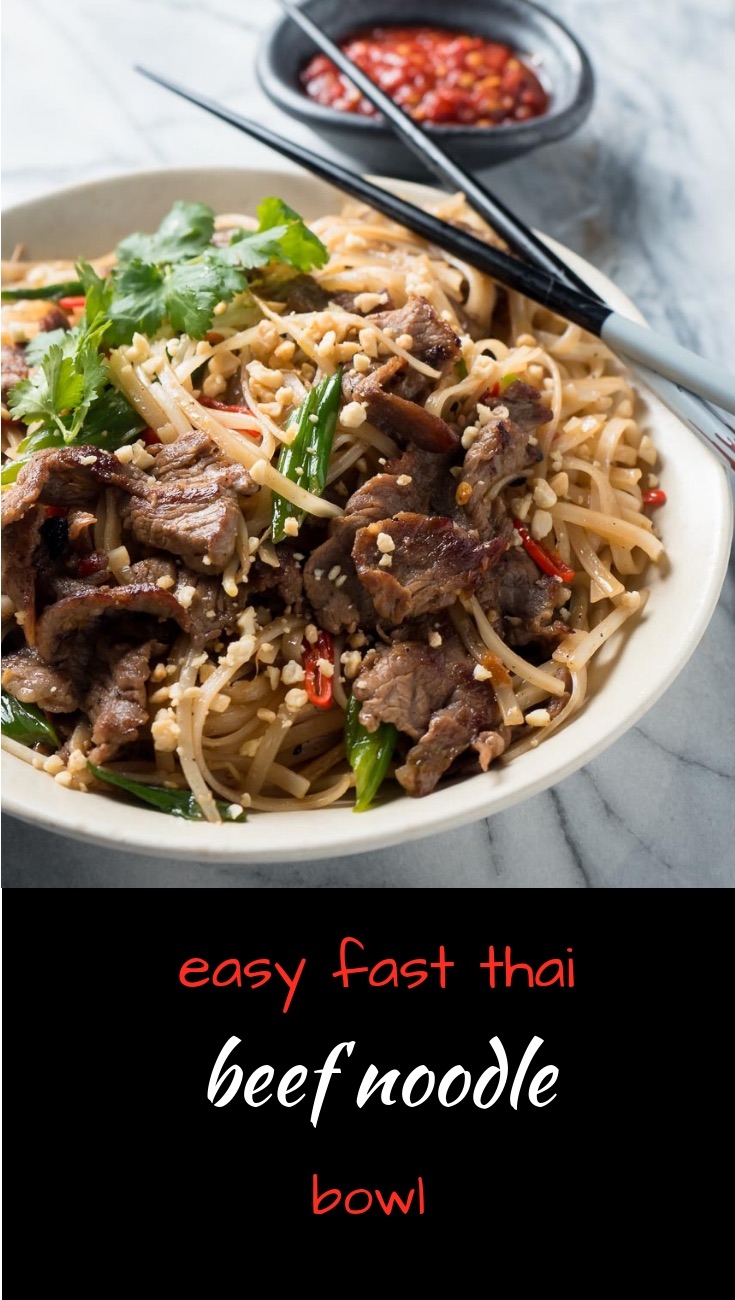
Thai beef noodles. Garlicky, sweet, salty, spicy. A little bit smoky. Lots of big flavours going on. Street food. At home. Seriously tasty stuff.
And it comes together fast. Weeknight fast. No reason to eat anything less than awesome every day.
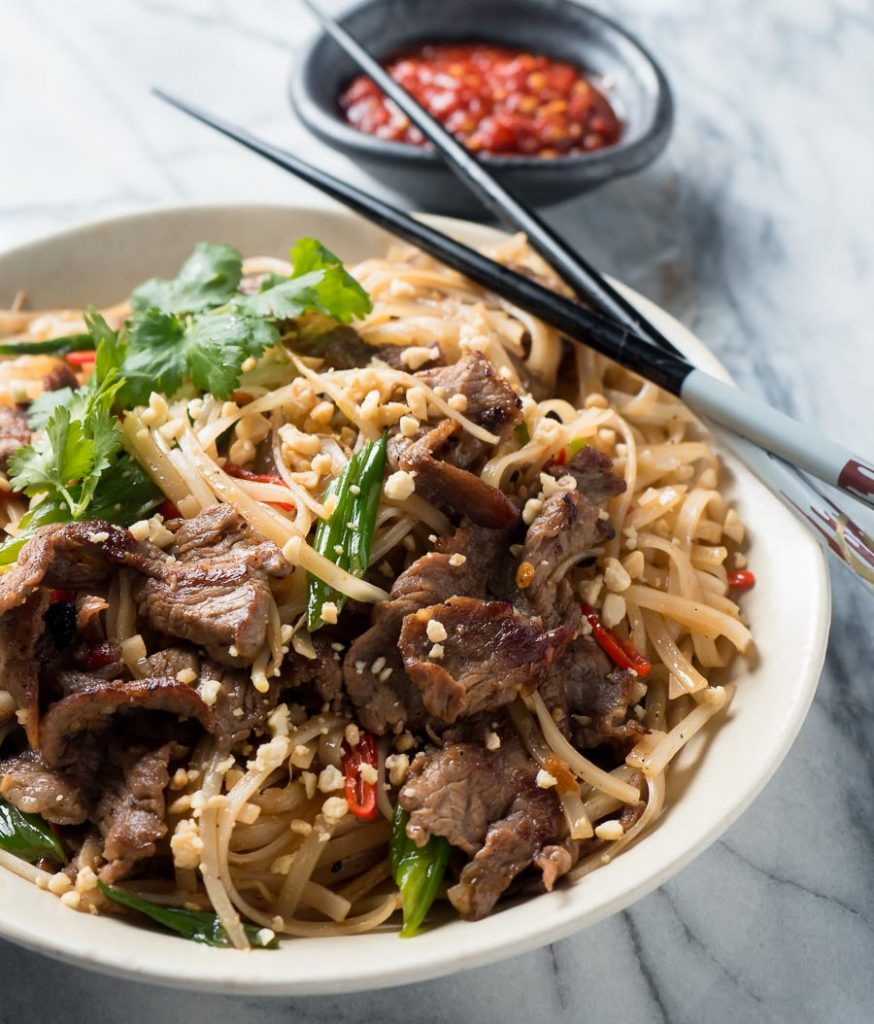
Thai beef noodles are street food
Imagine you were in Thailand and you ordered this on the street. The guy making it would have his prep done. You should too. This goes fast.
Heat up a wok and go. Cook the beef. After that, you’ll have Thai beef noodles on the table in a couple minutes. Yes, that fast.
You should probably only make two servings at a time. Too much stuff in the wok makes steam. Steam is bad. Steam makes soggy noodles. And you don’t want that.
You want to fry the noodles. Nicely coated with oil is what you are after. Repeat after me. Fried is not steamed. Fried is not boiled.
The trick is to cook all your beef up front. Have it ready to go and the rest comes together in a couple minutes. Literally. Two minutes an order. Street food.
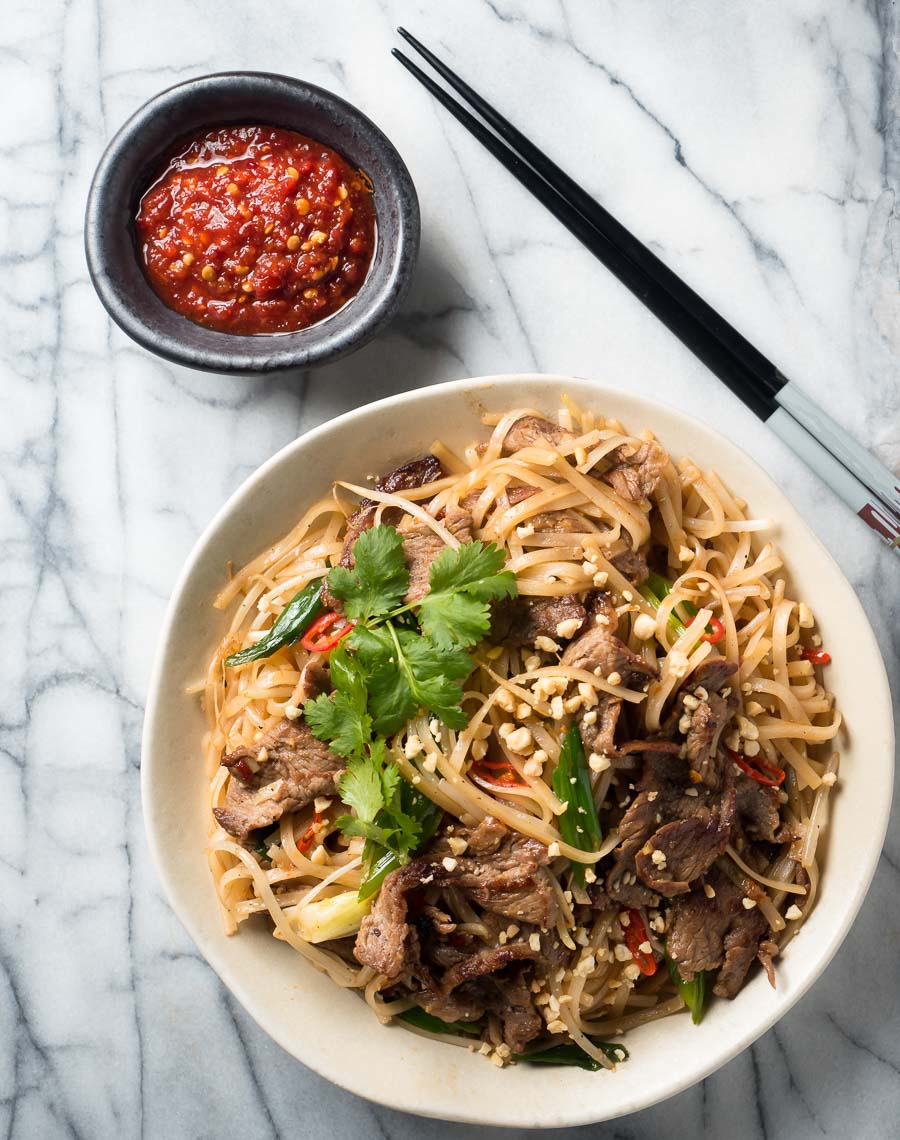
Big heat is the key
Restaurants have high output burners. Seriously high output burners. That street vendor? He does too.
That’s how they get that smoky stir fried taste. Regular stoves don’t have that kind of juice.
So you need to adapt. Turn your heat up to max. Don’t be scared. Even at max heat you aren’t close to what they are using.
Fry your beef in batches. If the heat isn’t high enough the beef with throw some liquid when it cooks. You’ll get grey beef. Boiled. You don’t want that. Remember. Boiled is not fried.
If you see it happen you have too much beef in the pan. Or not enough heat. Or both.
Don’t panic. Spoon out the liquid. Add a bit more oil. Turn up the heat. Get that beef to brown.
Same goes for the rest of the dish. You want that smoky flavour. It’s magic.
Keep the heat high. Work fast. If you can taste a bit of smoke in the final dish you’ll know you nailed it. You’ll be spoiled for life. It’s so good.
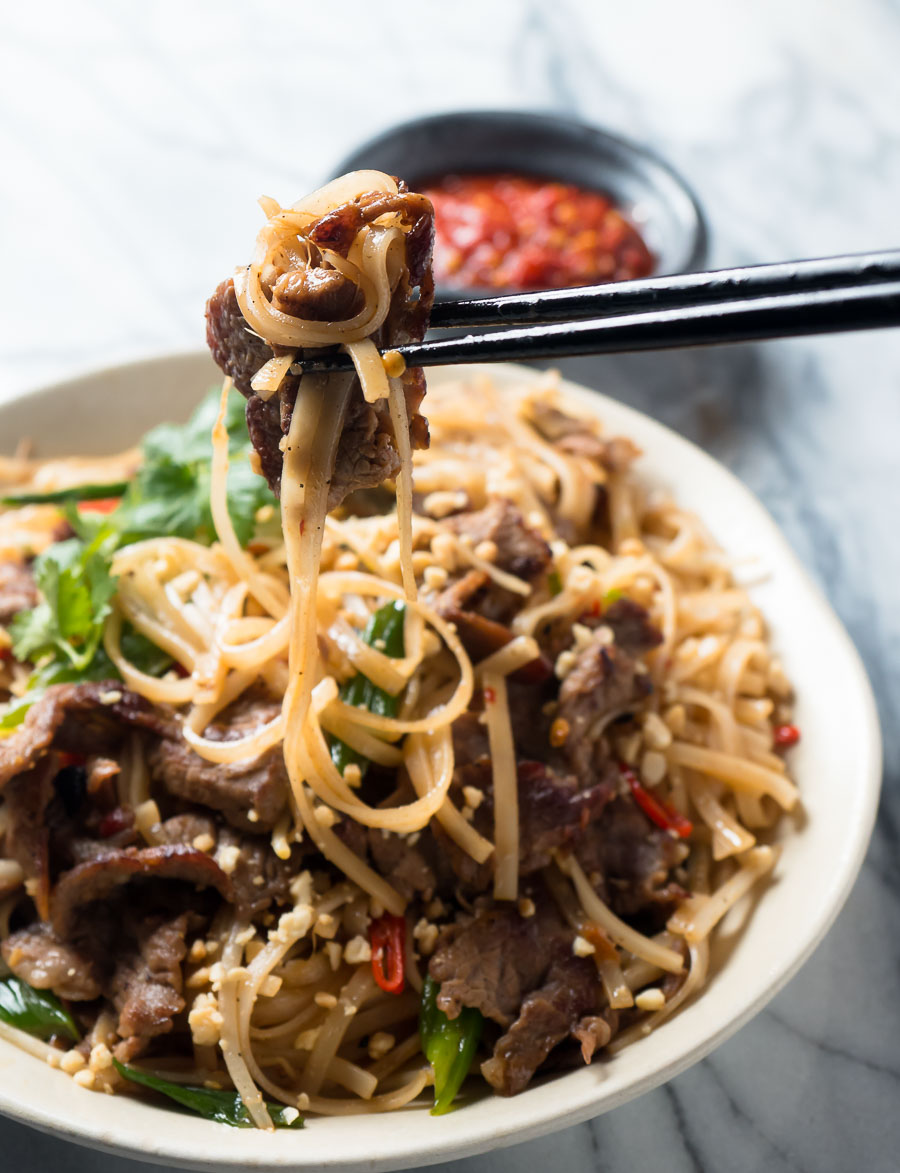
Noodles matter for Thai beef noodles
As with any Thai noodle dish, the noodles are key. Do not boil your rice noodles. Just don’t do it. Instead, soak them for about 45 minutes in warm water. They will soften just enough.
Then toss them in hot oil until they are well coated. Fry them. Do this before you add the sauce. It works.
Thai beef noodles. Restaurant flavour. Street food fast. Easy. Delicious. Try it. You’ll be glad you did. It’s perfect weeknight food.
thai beef noodles
Ingredients
The stir fry
- 7 oz rice noodles – also known as ban pho
- 8 oz beef top sirloin or flank steak, sliced across the grain
- 2 large cloves garlic minced
- 1 red finger hot chili cut into fine rings
- 1 cup green onions cut into 1 inch pieces
- 1 cup bean sprouts rinsed
- 1 Tbsp roasted peanuts pretty finely chopped
- 2 Tbsp cilantro leaves chopped
- 3 Tbsp vegetable oil in all
Marinade
- 1 Tbsp low sodium soy sauce – or Thai thin soy sauce if you have it
- 2 cloves garlic minced
- 2 Tbsp sake
- 1/2 tsp brown sugar
Sauce
- 1 Tbsp Thai thin soy sauce – if you can’t find Thai thin soy go with what you have
- 2 Tbsp fish sauce – don’t fear the fish sauce. Never fear the fish sauce.
- 2 Tbsp sake
- 1 1/2 Tbsp brown sugar
- 1 tsp sambal oelek – I like 2 tsp but I like a little spicy
Instructions
- Soak the noodles in warm water for 30-45 minutes.
- Combine the marinade ingredients. Add the beef and set aside while you prep the other ingredients.
- Mix together the sauce ingredients and stir well.
- Heat a wok over high heat. Add 1 Tbsp oil.
- When the oil is shimmering, add the beef and marinade and cook until the beef loses its red colour, about 2 minutes. If the beef throws some liquid spoon it out. Add a bit more oil. Turn up the heat. Brown your beef. Grey is bad. Brown is good. Go a little longer if you have to. You really want some brown.
- Remove beef and wipe out the wok with paper towel. Return the wok to high heat.
- Add 2 Tbsp oil. When the oil is shimmering, add the green onion, garlic and red chili and cook about 15-30 seconds. You are going to get some of the smoky flavour from the onions so don’t lay off the heat.
- Add the noodles and stir until well coated with oil – about 30-45 seconds.
- Return the beef to the wok along with the bean sprouts. Stir briefly and add the sauce. Add half the peanuts. Stir to combine and cook, stirring constantly, for one minute.
- Add cilantro and stir.
- Serve topped with the rest of the peanuts and additional cilantro.
Notes
Nutrition
thai beef noodles
Ingredients
The stir fry
- 7 oz rice noodles - also known as ban pho
- 8 oz beef top sirloin or flank steak, sliced across the grain
- 2 large cloves garlic minced
- 1 red finger hot chili cut into fine rings
- 1 cup green onions cut into 1 inch pieces
- 1 cup bean sprouts rinsed
- 1 Tbsp roasted peanuts pretty finely chopped
- 2 Tbsp cilantro leaves chopped
- 3 Tbsp vegetable oil in all
Marinade
- 1 Tbsp low sodium soy sauce - or Thai thin soy sauce if you have it
- 2 cloves garlic minced
- 2 Tbsp sake
- 1/2 tsp brown sugar
Sauce
- 1 Tbsp Thai thin soy sauce - if you can’t find Thai thin soy go with what you have
- 2 Tbsp fish sauce - don’t fear the fish sauce. Never fear the fish sauce.
- 2 Tbsp sake
- 1 1/2 Tbsp brown sugar
- 1 tsp sambal oelek - I like 2 tsp but I like a little spicy
Instructions
- Soak the noodles in warm water for 30-45 minutes.
- Combine the marinade ingredients. Add the beef and set aside while you prep the other ingredients.
- Mix together the sauce ingredients and stir well.
- Heat a wok over high heat. Add 1 Tbsp oil.
- When the oil is shimmering, add the beef and marinade and cook until the beef loses its red colour, about 2 minutes. If the beef throws some liquid spoon it out. Add a bit more oil. Turn up the heat. Brown your beef. Grey is bad. Brown is good. Go a little longer if you have to. You really want some brown.
- Remove beef and wipe out the wok with paper towel. Return the wok to high heat.
- Add 2 Tbsp oil. When the oil is shimmering, add the green onion, garlic and red chili and cook about 15-30 seconds. You are going to get some of the smoky flavour from the onions so don’t lay off the heat.
- Add the noodles and stir until well coated with oil - about 30-45 seconds.
- Return the beef to the wok along with the bean sprouts. Stir briefly and add the sauce. Add half the peanuts. Stir to combine and cook, stirring constantly, for one minute.
- Add cilantro and stir.
- Serve topped with the rest of the peanuts and additional cilantro.
Notes
Nutrition
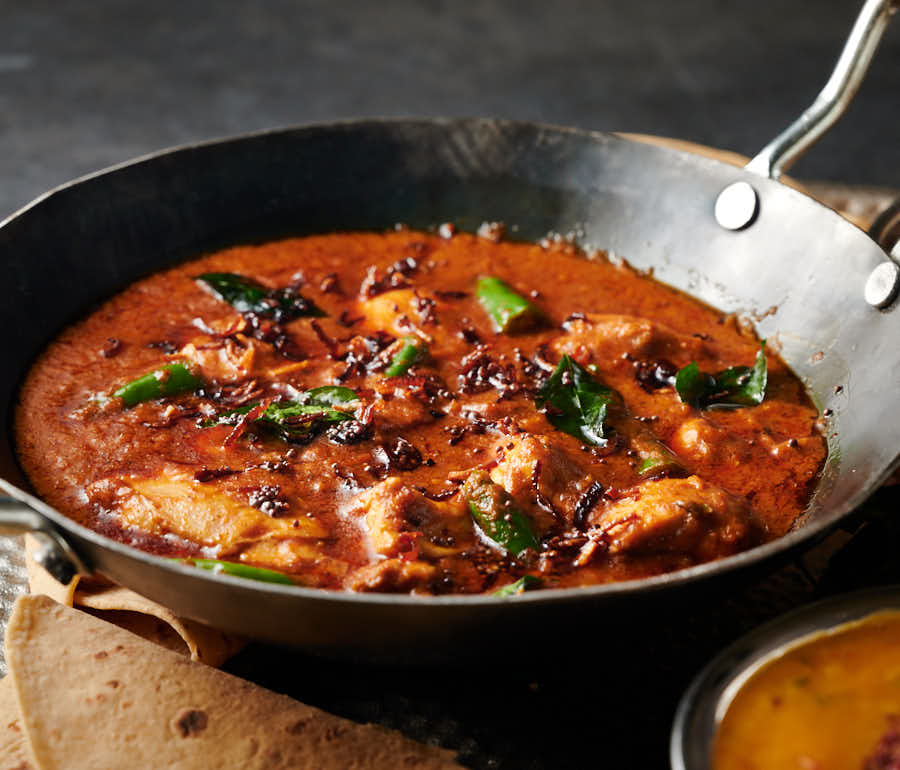
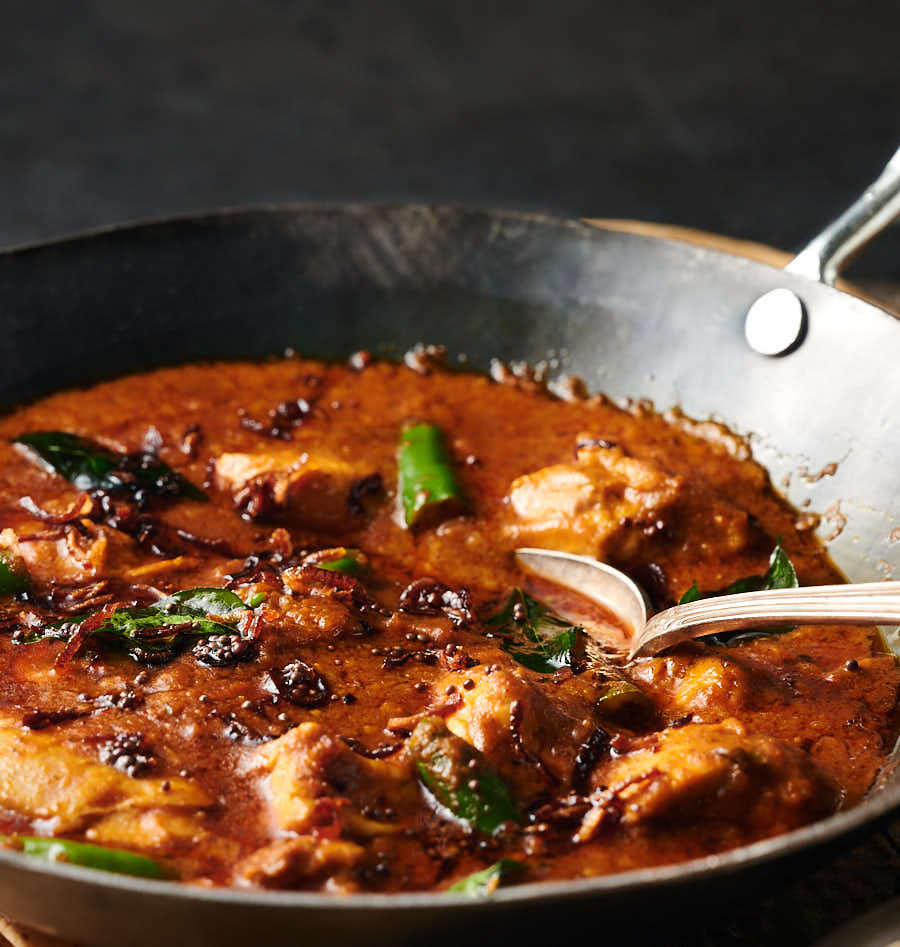
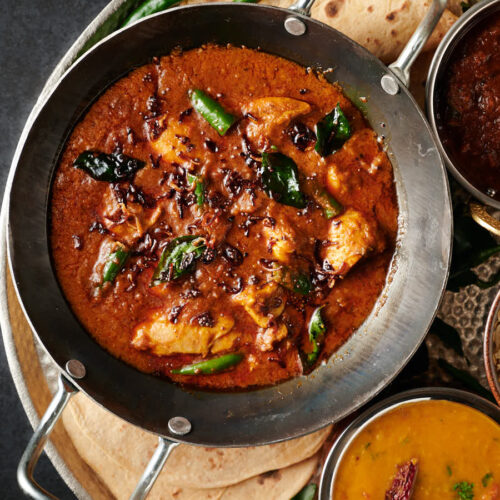
Kerala chicken curry. Nadan kohzi. Never heard of it? Too bad. You are missing out.
Curry leaves. Green chilies. Tamarind. Coconut. And a bold spice mix. Kerala masala is what makes this one special.
Big flavours. If you are looking to give your tastebuds a kick nadan chicken curry is a good place to start.
Black pepper is the backbone of Kerala chicken curry
This isn’t a run of the mill curry. And the spicing isn’t run of the mill either. Kerala chicken curry is a little different.
It’s the pepper that does it. Think garam masala. Now think garam masala with bite. Wonderful, peppery bite. That’s what’s going on here.
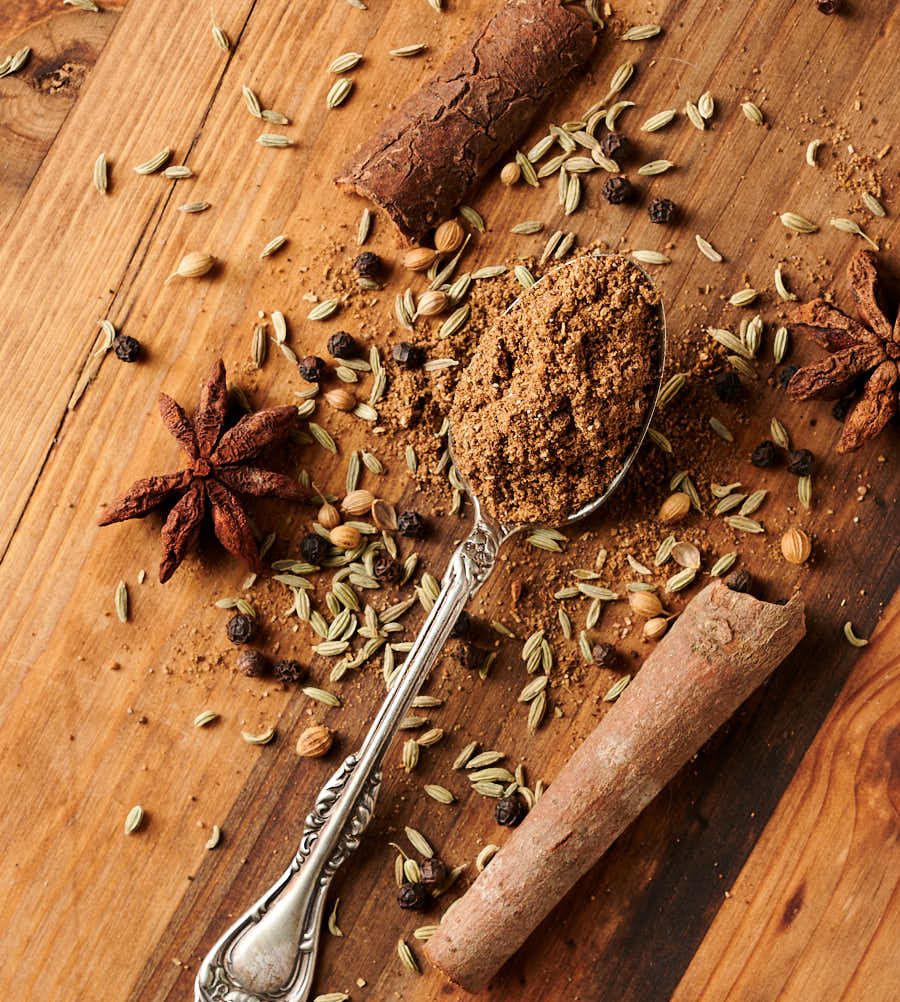
This is a complex mix. Haunting flavours. Cardamom. Cinnamon. Star anise. Fennel seed. Warm spices. But with attitude. Black pepper attitude.
Toasting and grinding spices makes a difference
If you usually use pre-ground spices you are in for a treat. There’s a world of difference here.
Dry roasted whole spices. Freshly ground. That’s a whole different league of tasty.
Normally I’d tell you to toast up a batch of spices and grind to order. That’s usually good advice.
But this time it doesn’t work. It’s a small batch. There’s only one star anise and one piece of cinnamon. So you need to grind it all up to make sure you get the balance right.
Roasted and fresh ground spices. You’ve heard about it. Now try it. It’s amazing. More work. Sure. But this blog isn’t ever about easy. It’s about going for gold.
I can smell my spice mix from across the kitchen as I write this. When was the last time that happened to you?
Fresh curry leaves matter
I put curry leaves first up above. There’s a reason. Fresh curry leaves are pretty important in this dish. Really important actually.
Most herbs work dried. Different. But they still offer something. Curry leaves are not like that. Think of dried cilantro. There’s no taste at all. Dust.
Dried curry leaves are a bit better. Maybe a 1 out of 10 on the flavour scale. If I’m feeling generous.
Just can’t get fresh? Don’t let that stop you. It will still be good. Just won’t be the same. The spice mix is amazing. It will totally carry the dish. Not exactly what I intended. But tasty.
If you want the real deal though try to find fresh. Where I am it’s not that hard. You do have to work a bit. But they are around. Just have to hunt.
If you live in a town with a South Indian restaurant go ask them. They will have them. Tell them you are making nadan kohzi. They will be impressed. Beg. It’s worth it.
And when you get them, they freeze pretty well. Way better than dried…
Hotel style kerala chicken curry
Hotel style curry gravy is the other thing that’s different about this curry. You probably know traditional Indian cooking. That’s pretty much everything out there. All the books. The whole internet.
Traditional is fantastic. I love it. Grew up eating it. My comfort food is Bengali chicken curry and dal.
This is different. But similar. It’s a way to prep a foundational base gravy that lets you make curries on demand. You make a bunch of the hotel base gravy and portion it out. You can freeze it for later. Hotel style on demand.
Regular restaurant technique is conceptually similar. But it comes at it a totally different way. It’s good. It’s easy. And it works.
Hotel style is about taking it up another level. Restaurant style is what they serve in your local Indian joint. Hotel style is what they serve at the Indian restaurants you can’t get a reservation at.
You get all the depth of flavour from slowly browned onions like traditional Indian cooking. But with the lush sauce of restaurant style. The best of both worlds.
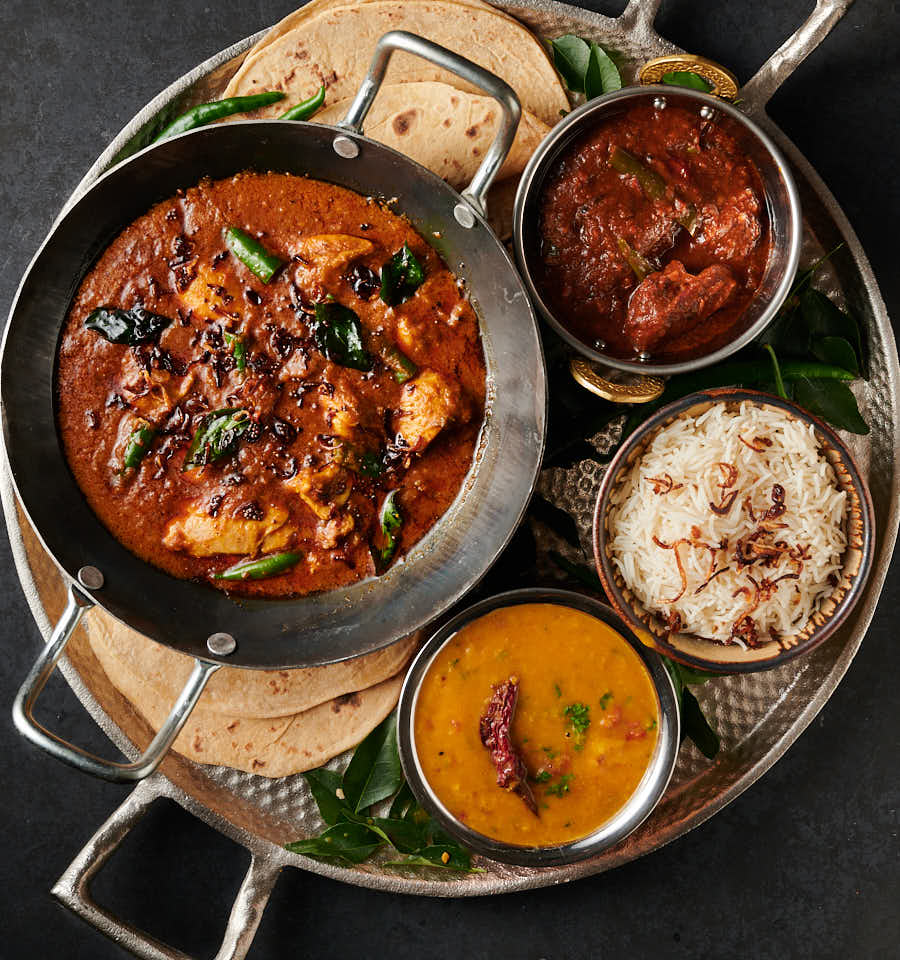
Hotel style Kerala chicken curry. Nadan kohzi. Doesn’t matter what you call it.
What matters is now you’ve heard of it. Try making it. I think you’ll like it. A lot.
kerala chicken curry – Indian hotel style
Ingredients
kerala masala
- 1 1/2 tbsp black peppercorns
- 1/2 tsp cumin seed
- 2 tbsp coriander seed
- 1 tsp fennel seed
- 1 inch cinnamon bark also known as cassia
- 1 star anise
- 8 cloves
- 8 green cardamom pods
The spice mix
- 2 1/2 tsp kerala masala – the ground spice. See above
- 1 1/2 tsp kashmiri chili powder
- 1/2 tsp kasoor methi – dried fenugreek leaves
- 1/4 tsp turmeric
- 1/2 tsp kosher salt
kerala chicken curry
- 3 tbsp coconut oil – any neutral oil will also work or even 1/2 and 1/2 coconut and neutral oil
- 1 tbsp garlic ginger paste – recipe link below
- the spice mix from above
- 2-3 finger hot (jwala) green chilies cut into 1 inch pieces
- 5 fresh curry leaves
- 1 cup Indian hotel curry gravy – recipe link below. Don’t worry if it seems too thick. The juices from the chicken will thin it out.
- 1/2 tsp tamarind paste – or tamarind pulp if you make it yourself. Tamarind concentrate is not the same thing as tamarind paste. Watch out for that.
- 3 boneless, skinless chicken thighs cut into 4 pieces each
- 3 tbsp coconut milk
Tempering
- 1 tbsp coconut oil
- 1/2 tsp mustard seeds
- 10 fresh curry leaves
- 1/2 shallot thinly sliced
Instructions
Make the kerala masala
- Pre-heat a small skillet over medium-low heat.
- Add the spices to the skillet.
- Toast, shaking the pan, until they start to get fragrant. This should take a two or three minutes.
- Let cool and grind to a fine powder. I like a coffee grinder for this. The old ones with the blade work well. Bad for coffee. Great for spices.
- You won’t need anywhere near all of it so transfer it to a jar with a tight fitting lid and store in a cool, dark place. Use it as a funky peppery garam masala if you like.
Do your prep
- Measure out your spice mix. Stem your curry leaves. Prep your chicken. Measure out a cup (237 ml) of Indian hotel curry gravy. Cut up your green chilies. Slice your shallot.
- Have your garlic ginger paste, tamarind and coconut milk handy. You’re good to go now.
Make your tempering
- Heat 1 tbsp of coconut oil over medium low heat in the same little pan you used to toast the spices.
- Add the shallots and cook until the shallots start to brown.
- Add the mustard seed and about 10 curry leaves and cook until the shallots are nicely brown. Set aside.
Make the kerala chicken curry
- Heat the oil in a medium sized frying pan until the oil just starts to shimmer.
- Stir in the garlic ginger paste. Gently fry until the garlic ginger paste stops sputtering. This can get a little messy.
- Turn your heat down to medium low and add your spice mix and the remaining 5 curry leaves. Cook for about 30 seconds. You want to fry your spices in the oil. Don’t skimp on the oil. Bad things happen if the spices stick and burn.
- Add the green chilies. Cook another 30 seconds or so.
- Add the Indian hotel curry gravy. Stir it really well to get the oil to combine with the curry gravy. You want everything mixed together at this point. Bring to a simmer.
- Add the chicken thigh pieces in a single layer. Nestle them down into the sauce. Cover and cook about 5 minutes. Remove the cover, flip the chicken and recover. Cook until the chicken is done. Use an instant read thermometer if you have one. You are shooting for an internal temperature of 160F. It will get to 170F as the curry finishes cooking.
- Add the tamarind paste and coconut milk. Stir well to combine.
- Look at the consistency. If you are happy with it, cover and simmer for 2 minutes. If it’s too thick, add a bit of water and stir to combine. If it’s too thin don’t cover it to let it reduce.
- While the curry is in it’s final simmer, warm up the tempering over low heat.
- Transfer the kerala chicken curry to a serving dish and drizzle/sprinkle it with the tempering.
- Kerala chicken curry is great with rice and chapatis or parathas.
