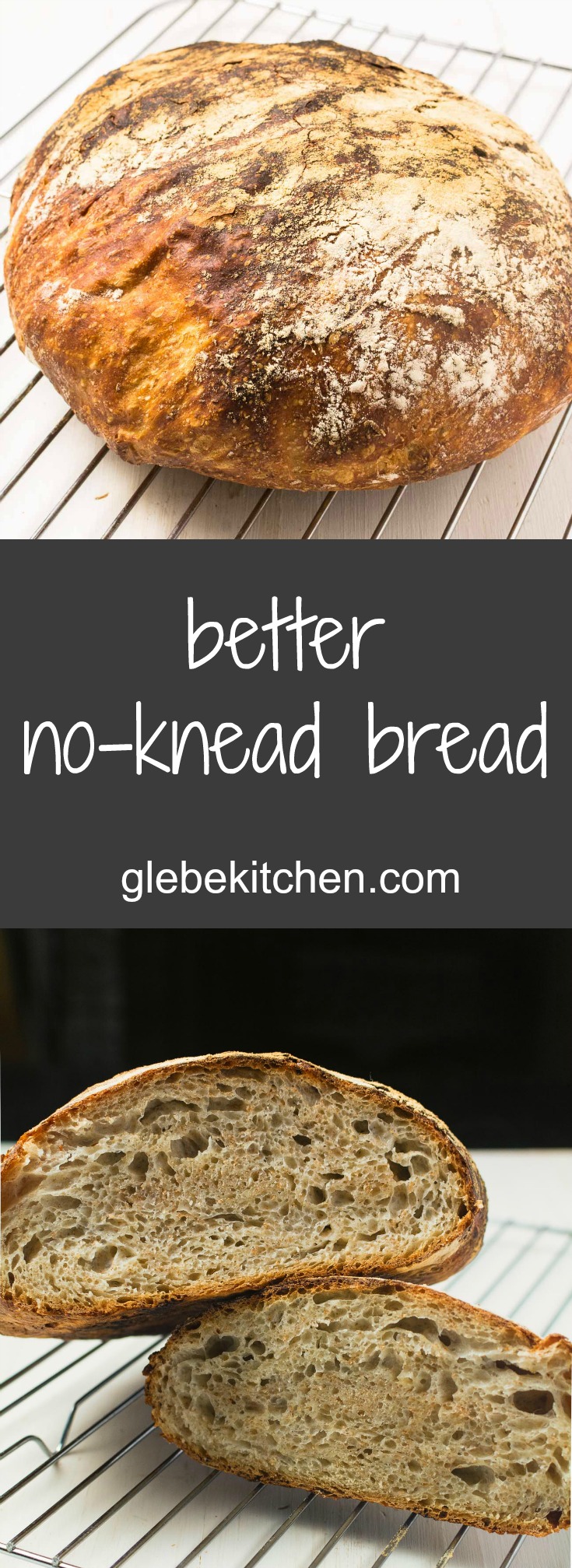
There’s a super popular article in the NY times by Mark Bittman about Jim Lahey’s no-knead bread. I looked at it, saw the pictures and thought I’d give it a try.
The beauty of this recipe is it teaches the benefit of longer fermentation. This no-knead bread takes about 24 hours to make. Time is a wonderful thing when making bread. Complexity happens. Depth of flavour results.
The NY times recipe, as written, is a bit vague. And a bit dangerous. The video has you throwing raw dough into a blazing hot dutch oven.
First off, measuring flour by volume is misguided at best. Bread bakers work by weight. I don’t know what the obsession is with volume is but if you are going to make bread or pizza dough do weigh your ingredients. Maybe professionals can stick their finger into dough and know it’s right. I can’t.
Second, understand that proofing is a function of time and temperature. The warmer the room, the faster things happen.
The recipe, as written, is for about a 70F room and a 12 to 18 hour initial proof. The real way to tell how your doing is to watch the bubbles forming on the surface of the dough. Bubbles means it’s good to go.
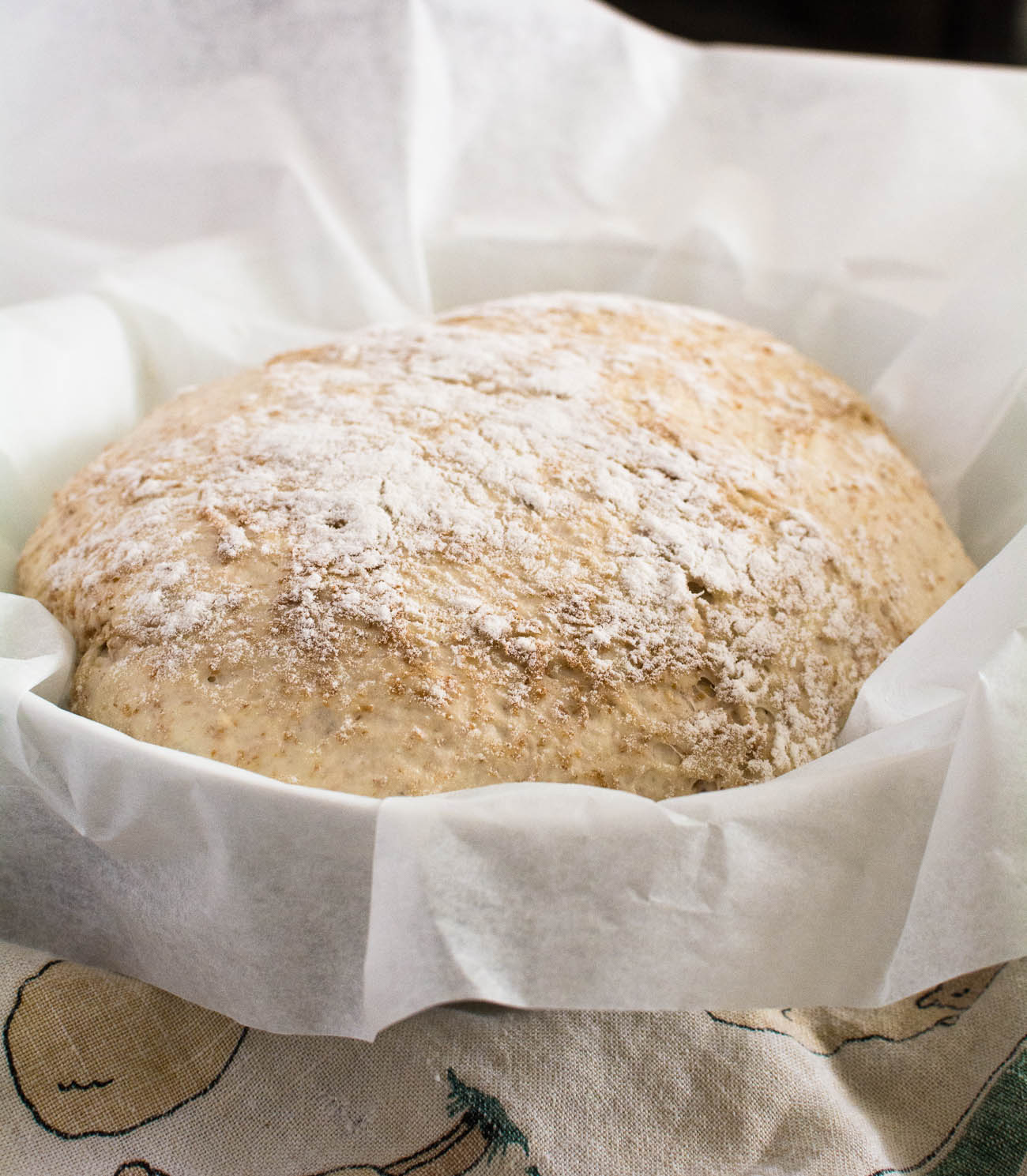
Third, tossing the dough in a 500F dutch oven is crazy. I do the second proof with parchment under the dough.
When it’s time to bake, I pick up the dough by the parchment and carefully drop it into the dutch oven. Cover it up and into the oven it goes. Safe.
no-knead bread
Ingredients
- 344 grams all purpose flour
- 86 grams of whole wheat flour
- 345 grams water - at around 90F
- 8 grams salt
- 1 gram instant rise yeast
Instructions
- Combine flour, salt and yeast in a large bowl.
- Add water and mix using your hands. This is a sticky mess.
- Cover with plastic wrap and let rise, undisturbed, for 12-18 hours. It’s ready when you see little bubbles forming on the surface of the dough.
- Cut a piece of parchment about 14 inches square. Sprinkle with a bit of flour. Flour your hands. Slide the dough out of the bowl onto the parchment.
- Fold the dough onto itself 4 times. You are taking one side of the dough and folding about 1/3 of the dough onto itself. Now do it on the other side. Rotate everything 90 degrees and repeat for the third and 4th fold. Watching the video in the link helps understand this.
- Flour your hands some more and flip the dough over so the folded side faces down and the smooth side is up. Try to shape the dough into a ball as best you can.
- Place the dough in a bowl to help it keep its shape.
- Flour the surface of the dough and place a tea towel over top. It’s sticky, sticky dough so don’t let the towel get too stuck.
- Place a 5-6 quart dutch oven in the oven and pre-heat to 475F.
- After about an hour remove the dutch oven and transfer the dough into the dutch oven using the parchment as a cradle. The parchment goes into the dutch oven along with the dough. Be careful here. The dutch oven is screaming hot.
- Cover the dutch oven and return it to the oven. Bake for 30 minutes.
- After 30 minutes remove the lid and cook for an additional 10-20 minutes. You are going for an internal temp of about 210 degrees.
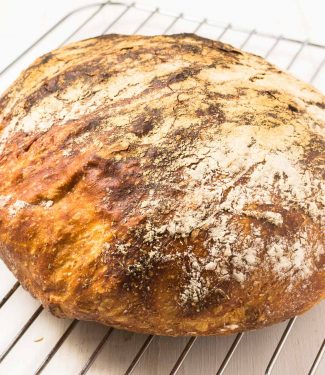
- When the bread is cooked, remove and transfer to a cooling rack. Let stand about an hour.
- Slice and be impressed with yourself.
Nutrition
Dopiaza curry is an ancient Indian dish that’s become a favourite worldwide. And it’s not surprising. Big, bold tastes of spice and lots of onions make this one seriously tasty curry.
Dopiaza hails from the Hyderabad region of India so it’s a South Indian homestyle curry that’s been adapted to work in restaurants. If you like onions, and you like curry, I think you’ll like a dopiaza curry.
Dopiaza curry gets its roots from Persian cuisine
There’s a bit of a legend around the origins of dopiaza. It was invented by accident when the cook of a Moghul emperor accidentally added way too many onions to a dish. Good thing the emperor liked onions. This could have ended badly for that cook.
The cook’s name was Do Piaza. His name lives on in this dish. Seems unlikely but who am I to question legend. It’s a good story anyway. And it’s a great curry. One that’s been refined over the years.
I like green chilies in my dopiaza curry. Big hunks of green chili. Gives it a little bit of a jalfrezi thing. That’s not so conventional. So if you want to stick to the more conventional version leave them out. Up to you.