Beef rogan josh is one of the first Indian curries I ever learned to cook. I got it from Madhur Jaffrey’s first book and I thought I was the cat’s meow.
People raved. It became a house favourite. It was pretty good. But this is better. Much better.
Beef rogan josh is slow food
You can’t rush this rogan josh. No way. Homestyle curries take time. Beef takes time. But it’s time that makes it all come together.
This is no different than any other beef stew. You need to go slow. This is a braise. And braising cannot be rushed. It’s a good thing. The house will smell incredible. You will be pleased with what you cook.
Take the time to brown the beef
Browning meat is not about colour. That’s a nice byproduct sure. But it’s about flavour. Depth of flavour. Complexity. There’s this thing called the Maillard reaction that happens when you brown.
Basically something wonderful happens when the amino acids and reducing sugars in the meat hit heat. Complex chemistry. Food science. But you don’t need to worry about that if you don’t want to. All you need to know brown is better. Way better.
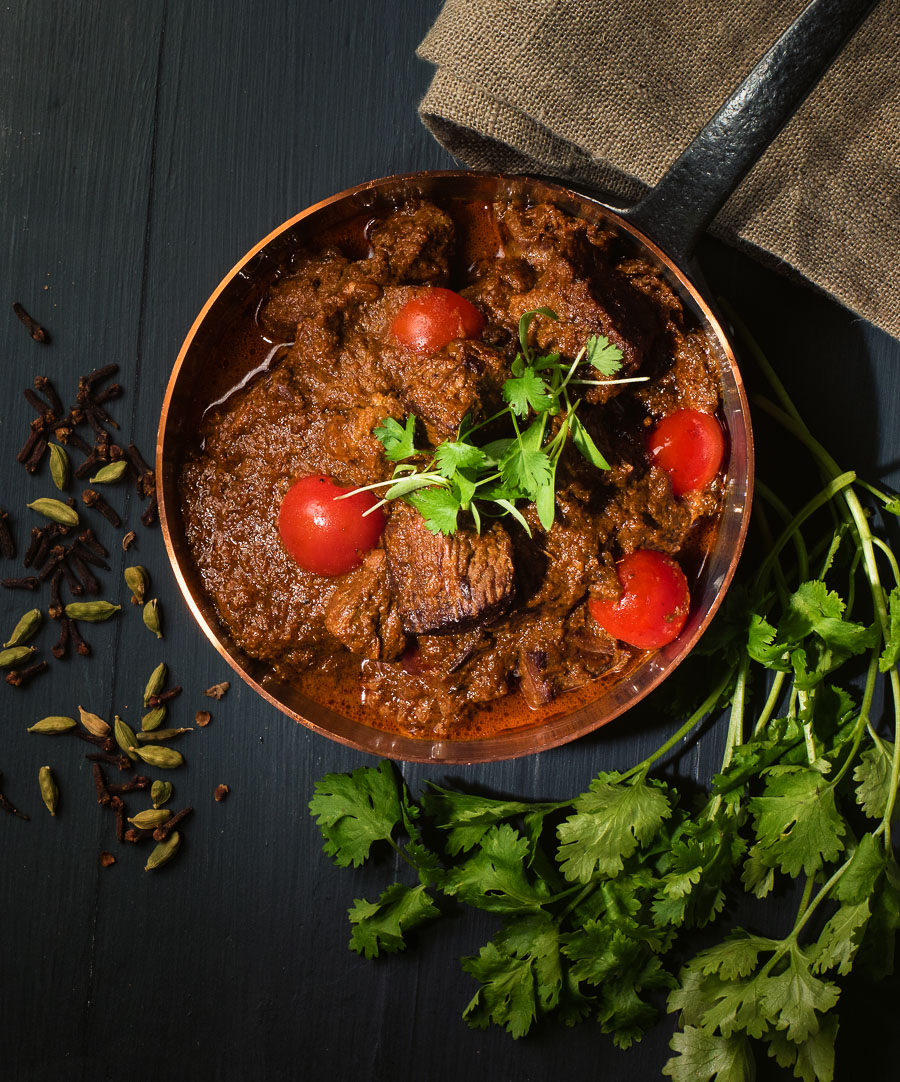
beef rogan josh
Ingredients
The curry
- 3 lbs beef - stew from the chuck is nice
- 1/2 cup vegetable oil
- 2 large onions - minced
- 1/4 cup garlic ginger paste - recipe link below
- 10 whole cloves
- 10 whole green cardamom pods
- 2 inch stick cinnamon bark
- 2 bay leaves
- the spice mix - below
- 5-6 Tbsp full fat greek yoghurt
- 2 cups water
- kosher salt - this is to taste. Start with about a big tsp and up it from there
- 10-12 cherry tomatoes - halved
The spice mix
- 1 Tbsp cumin
- 2 tsp coriander
- 2 tsp indian spice mix - recipe link below
- 1 tsp tandoori masala - available at any Indian grocery
- 2 tsp kashmiri mild chili powder - or 1/2 tsp cayenne with 1 1/2 tsp paprika
- 2 tsp paprika
- 1 tsp kasoor methi - dried fenugreek leaves
- 1/2 tsp black pepper
Instructions
- Pre-heat the oven to 325F.
- Heat the oil in a dutch oven over medium heat.
- Work in batches. Lightly brown the meat in batches. Don’t crowd the meat. Leave a half inch around pieces. It doesn’t have to be super brown like when making a good French stew but it does need to be brown. Set the beef aside.
- If you need more oil add it now. Then add the onions to the same pot used to brown the beef. Cook until soft and well browned, about 10 minutes. Regulate the heat so the onions don’t burn.
- Reduce heat to medium low. Move the onions to the outer edges and add a splash of oil. Add the whole spices (cloves, cardamom, cinnamon and bay) and cook about 30 seconds.
- Leaving the onions on the edge, add the spice mix. Cook for around 90 seconds, stirring constantly. You want enough oil to keep everything wet. If it looks dry, add a Tbsp or two of vegetable oil.
- Mix in the garlic ginger paste and cook another 30 seconds or so.
- Return the meat and accumulated juices and scrape up any browned bits in the bottom of the pot.
- Now mix in the yoghurt one Tbsp at a time. Stir it in before adding the next one. I don’t know why this is important but Madhur Jaffrey says so. I still do it. It has never gone wrong. Probably, it doesn’t make any difference but, well, Madhur says so and who am I to differ.
- Now add a big tsp of salt with enough water to almost cover the meat.
- Cover and place in the pre-heated oven. Cook until the meat is tender, about 2-2 1/2 hours. Give it a stir every 30 minutes.
- When the beef is tender remove the pot from the oven and place over medium low heat. If the curry is dry, add a bit of water. If it’s wet, simmer uncovered to reduce. You want the sauce to be the consistency of heavy cream.
- Let stand a couple minutes to allow the oil to separate. Spoon it off carefully. You should get nearly all your 1/2 cup of oil back. If you don’t mind the calories though, leave some of it in the curry. That oil is loaded with spice flavour.
- Adjust salt and add the cherry tomatoes. Simmer for about 5 minutes.
- Serve with basmati rice.
Notes
Nutrition
Korean style pork chops are a little bit spicy, a whole lot savoury and loaded with flavour. Try them when your everyday pork chops just won’t do.
I love a good pork chop. And Korean style pork chops are one of my favourite ways to serve them up. Something about the umami-ness (like that’s a word) makes me smile.
Get to know Korean food
I have a thing for Korean food. Not sure why it isn’t more popular. It’s a little bit spicy. And it’s different from other Asian cuisines. Distinct.
It’s not all about kimchi and Korean BBQ either. Korean is a rich culture with diverse cooking styles and tastes. It’s getting known though.
I have a Korean grocery near my house now. And most Asian groceries carry a lot of Korean these days. So it’s not that far out there.
Korean is a little bit spicy. Not mouth searing like some Asian cuisines but it does have a bit of a kick. Balanced. Savoury. Give it a try.
Korean pork chops are easier than you think
Korean style pork chops take about 5 minutes to prep and cook up in no time flat. A few ingredients, a quick marinade and your ready to go.
There’s nothing too exotic here. Nothing crazy complicated. You might need a trip to an Asian grocer but you will be glad you went.
Gochujang – Korea’s secret weapon
One of the backbone seasonings in Korean cooking is gochujang. It’s what makes these Korean style pork chops what they are.
Gochujang is a Korean chili paste. It’s not scary. Not strange. It’s not some weird fish concoction. If you’ve ever had Korean, you’ve had gochujang. It’s like miso with some heat. Not exactly. But pretty close.
You can get it at pretty much any Asian market. If you can’t find it, mixing sriracha and miso comes pretty close.