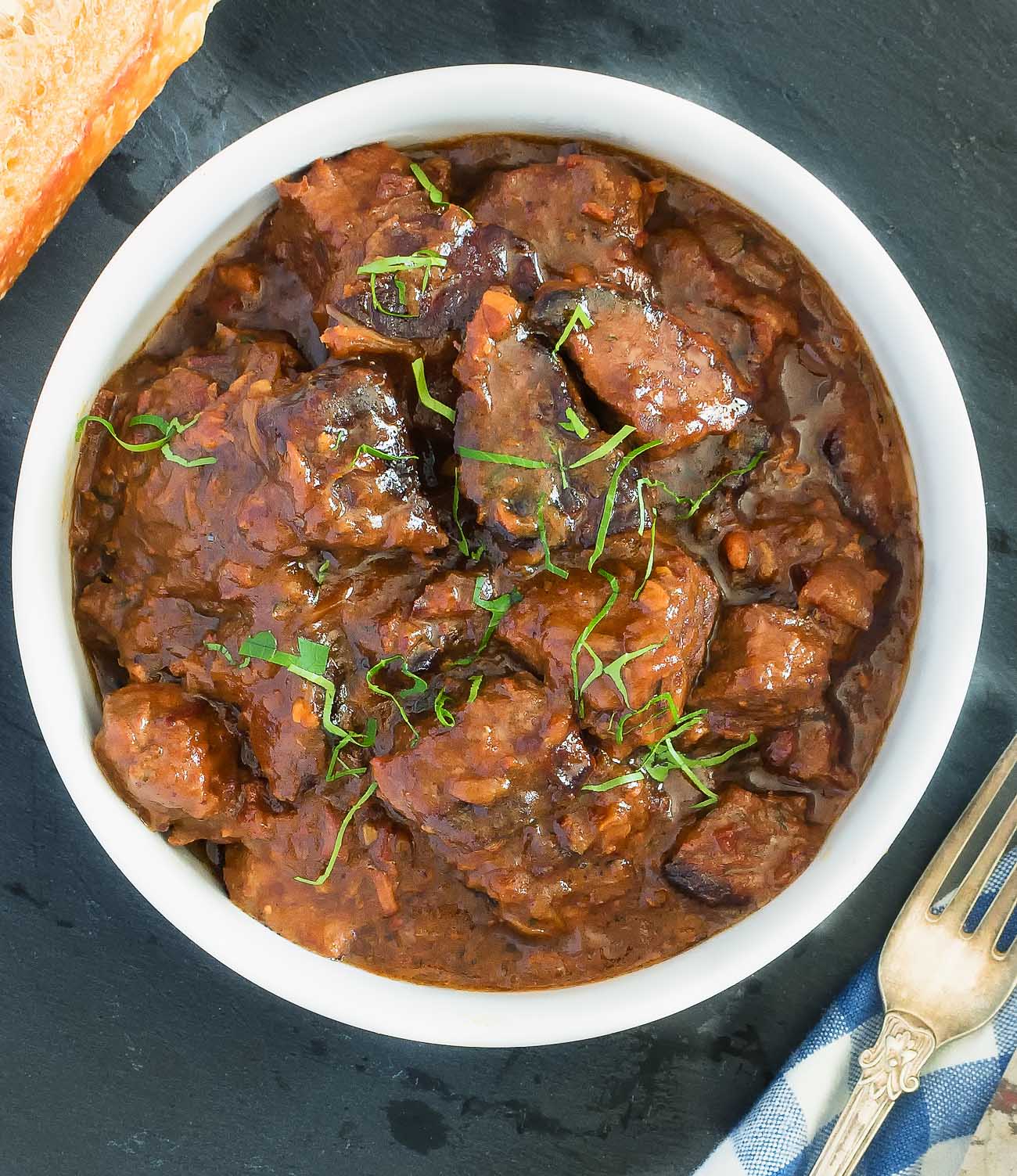
Beef and beer stew – carbonnade a la flamande – is all about the beef, the beer and the onions.
Browned beef. Caramelized onions. Brown Ale. A little bit sweet from the sugar. A little bit sour from the vinegar. A little bit smoky from the bacon. Everything in balance. Delicious.
Beer and beef stew is slow food. Weekend food. Food to impress if you take time and care. Brown the feef in batches. Really cook the onions. Like you’re making French onion soup.
A good stew is dinner party worthy. And beer and beef stew is good stew.
Beer and beef stew cooks in the oven
You want the onions to melt into the final sauce. Take 30 minutes or more for this step. Once you’ve done that you are on auto-pilot.
Cover your pot of stew and stick in a 325F oven and wait. For a couple hours. Maybe check in once in a while to make sure there’s enough liquid.
That’s the beauty of stew. Do work up front, then sit back and relax. Invest up front and you’re sure to get something wonderful at the other end.
You can’t rush carbonnade a la flamande
If you take one thing away from this recipe, make it that browning beef takes time. The beef will throw liquid as it cooks. If you’ve ever browned beef for stew you’ve seen it.
If you overcrowd the beef, it will cook in the liquid. That’s boiled beef. And that’s a shame. You want brown. Brown tastes good. Look up Maillard reaction. It’s critical to cooking.
Leave at least a quarter inch between all the pieces. Work in batches. You will get browned beef. Don’t do this and you will get boiled beef.
Serve beef and beer stew – carbonnade a la flamande with boiled potatoes and carrots. Or with good crusty bread and a green salad. Or even with mashed potatoes. Stew with mashed potatoes. Comfort city.
Serve it to good friends. Eat. Drink. Enjoy.
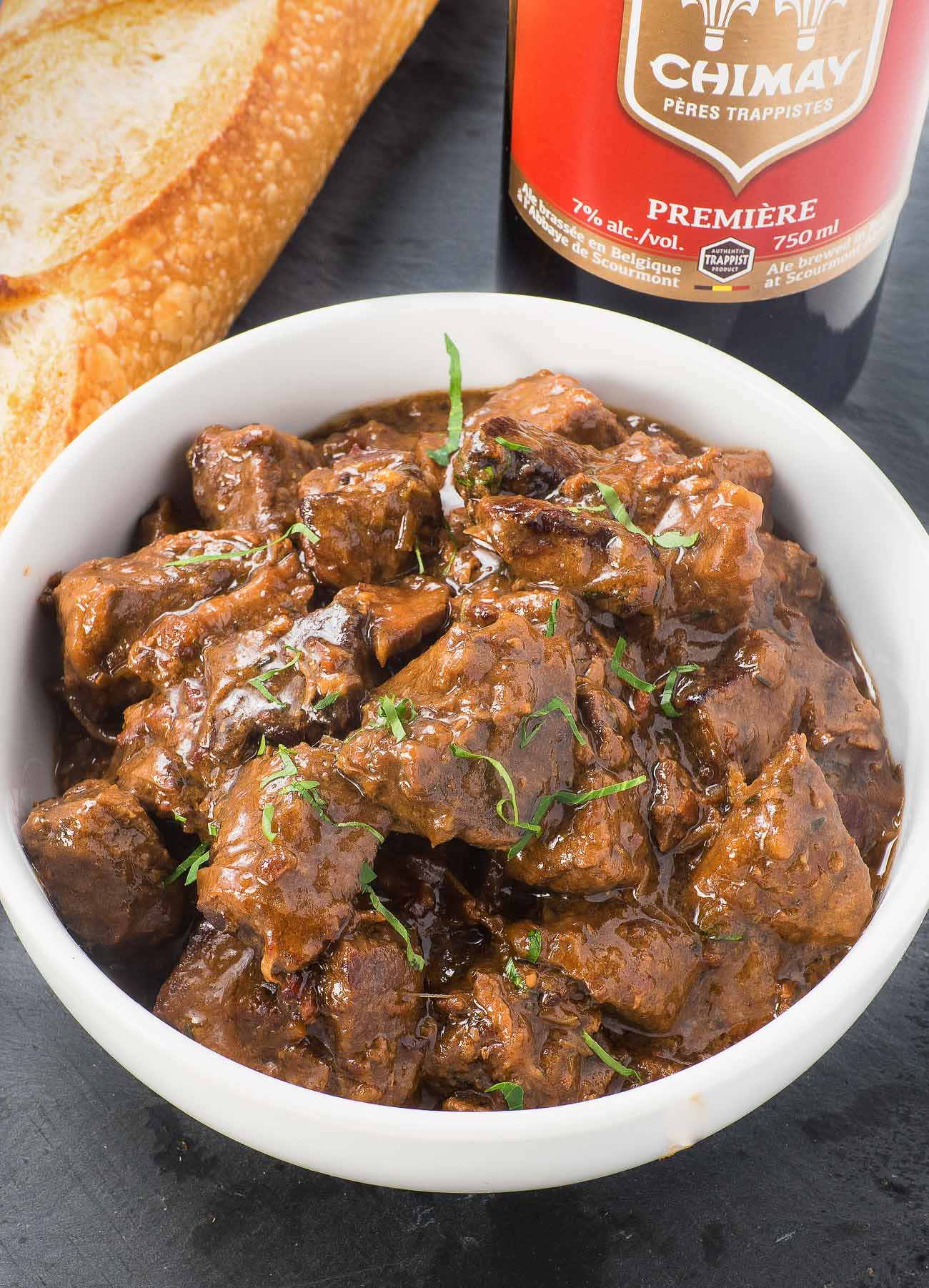
beef and beer stew – carbonnade a la flamande
Ingredients
- 4 lbs beef stew – chuck is nice for this
- 6 pieces bacon – good quality
- 3 large onions sliced thin
- 3 cloves garlic crushed
- 3 Tbsp flour
- 3 cups belgian dark ale – look for a Dubbel like Chimay
- 3 sprigs fresh thyme
- 2 bay leaves
- 1 Tbsp brown sugar
- 1 Tbsp cider vinegar
- 1 Tbsp dijon mustard
- Vegetable oil as required to brown the meat.
- Chicken stock as required to cover the beef.
Instructions
- Heat a large dutch oven over medium low to medium heat (you will need to find the browning sweet spot).
- Add 2-3 Tbsp of oil to the dutch oven.
- Working in batches brown the beef well. Be careful not to overcrowd the pan. If you get a big puddle of liquid in your pan, it’s overcrowded. You are boiling your beef. That’s bad. It took 5 batches in a 6 quart dutch oven for 4 lbs of beef.
- Dice the bacon into 1/4 inch pieces and add to the dutch oven along with the leftover oil and goodness. Cook to render the fat and add the thinly sliced onions. Add a bit of salt and cook, covered, for 20 minutes. Stir occasionally. Uncover and cook another 10 minutes. You are going for meltingly tender onions. Think French onion soup. It may take a little longer but it’s worth it.
- Add the crushed garlic and flour and cook another 2 minutes, stirring well.
- Mix the mustard with a little beer to dissolve.
- Add about 1/2 cup of the beer and scrape up any browned goodness on the bottom of the dutch oven.
- Pour in the rest of the beer, along with the mustard, cider vinegar, brown sugar, bay and fresh thyme. Add a bit of fresh ground black pepper as well.
- Return the beef to the pot along with any accumulated juices.
- Add just enough chicken stock to cover the beef. You may not need any at all.
- Add a good tsp of salt at this point, cover and place in a 325F oven for about 2 to 2 1/2 hours.
- Start checking at about 90 minutes. You are done when the beef is tender.
- At this point adjust the salt to taste.
- This is traditionally served with boiled new potatoes and carrots. I like it with a green salad to start and crusty bread.
Nutrition
beef and beer stew - carbonnade a la flamande
Ingredients
- 4 lbs beef stew - chuck is nice for this
- 6 pieces bacon - good quality
- 3 large onions sliced thin
- 3 cloves garlic crushed
- 3 Tbsp flour
- 3 cups belgian dark ale - look for a Dubbel like Chimay
- 3 sprigs fresh thyme
- 2 bay leaves
- 1 Tbsp brown sugar
- 1 Tbsp cider vinegar
- 1 Tbsp dijon mustard
- Vegetable oil as required to brown the meat.
- Chicken stock as required to cover the beef.
Instructions
- Heat a large dutch oven over medium low to medium heat (you will need to find the browning sweet spot).
- Add 2-3 Tbsp of oil to the dutch oven.
- Working in batches brown the beef well. Be careful not to overcrowd the pan. If you get a big puddle of liquid in your pan, it’s overcrowded. You are boiling your beef. That’s bad. It took 5 batches in a 6 quart dutch oven for 4 lbs of beef.
- Dice the bacon into 1/4 inch pieces and add to the dutch oven along with the leftover oil and goodness. Cook to render the fat and add the thinly sliced onions. Add a bit of salt and cook, covered, for 20 minutes. Stir occasionally. Uncover and cook another 10 minutes. You are going for meltingly tender onions. Think French onion soup. It may take a little longer but it’s worth it.
- Add the crushed garlic and flour and cook another 2 minutes, stirring well.
- Mix the mustard with a little beer to dissolve.
- Add about 1/2 cup of the beer and scrape up any browned goodness on the bottom of the dutch oven.
- Pour in the rest of the beer, along with the mustard, cider vinegar, brown sugar, bay and fresh thyme. Add a bit of fresh ground black pepper as well.
- Return the beef to the pot along with any accumulated juices.
- Add just enough chicken stock to cover the beef. You may not need any at all.
- Add a good tsp of salt at this point, cover and place in a 325F oven for about 2 to 2 1/2 hours.
- Start checking at about 90 minutes. You are done when the beef is tender.
- At this point adjust the salt to taste.
- This is traditionally served with boiled new potatoes and carrots. I like it with a green salad to start and crusty bread.
Nutrition
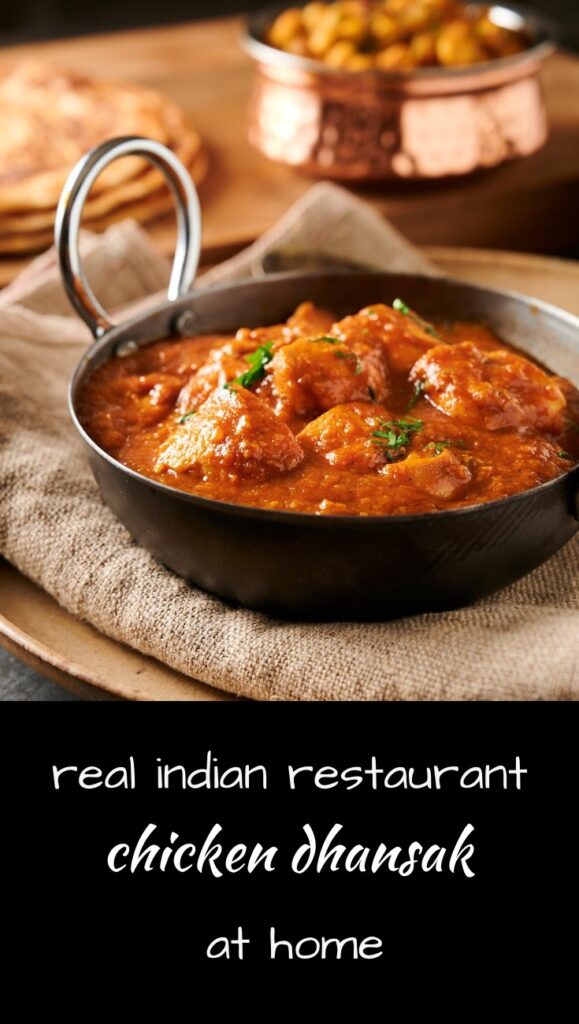
Dhansak is a famous Parsi dish. Indian restaurant dhansak curry is adapted from the traditional. But the big flavours, lentils and a bit of sweet and sour remain.
Dhansak gets it roots from Persian cuisine
Little bit of history. The Parsis were from Persia and migrated to India to escape persecution in or around the 10th century. That’s the beauty of history.
People move around. They bring their cooking with them. Don’t mean to oversimplify but immigration is good for food. Diversity. Variety. Ideas.
My guess is this dish started out as a way to stretch a relatively rare and expensive ingredient – meat – with plentiful and cheap lentils.
It’s a wonderful dish done the original way. Try that some time. It’s also really good done the Indian restaurant dhansak curry way. Try that too.
The lentils give the sauce it’s body
The lentils are cooked until they disintegrate. They disappear into the sauce but they bring body and smoothness.
The sweet and sour notes come from tamarind sauce. If you don’t want to get tamarind sauce use a bit of sugar and fresh lemon juice. Don’t worry – it will still qualify as Indian restaurant dhansak curry.
Tamarind sauce is not the same as tamarind paste
This recipe calls for tamarind sauce. Specifically I use Maggi Tamarina. I don’t like to call out product names if I can avoid it. But this is pretty important.
There are different tamarind products out there. You can get a block of tamarind and make it yourself. That’s hard.
You can buy tamarind concentrate or tamarind paste. That’s pretty much pure tamarind and has a far stronger tamarind flavour.
If you want to substitute tamarind paste use 1 tsp or 2 tsp sugar. That should give you about the same flavour profile. Not exactly the same. But close.
Make it with chicken, lamb or beef – or serve it as a lentil curry
This curry works well with chicken, lamb or beef. It’s great as a vegan lentil dish. Increase the lentils to about a cup and just don’t add any meat.
That’s actually better depending on your mood. Could be the best lentil dish ever. Creamy lentils with in your face dhansak flavours.
Always do your prep for Indian restaurant style cooking
Do your prep before you get started. Make your curry base and have some heated and ready to go. Pre-cook your meat.
Measure out your ingredients. Have everything ready. Restaurant style Indian curries take about 10 minutes to cook. There is no time to fiddle once you get started.
Oh, and put on some old clothes. A bit of splatter is part of the fun but turmeric stains are murder to get out. Don’t say I didn’t warn you.
If you read the guide to Indian restaurant technique yet, do it now. It has pictures to help you understand the recipe. There’s also a guide to Indian ingredients in that post.
Indian restaurant dhansak curry is a great dish. Creamy from the lentils with a great balance of savoury and sweet. If you are a fan of Indian food this one hits the spot. Just really, really tasty.
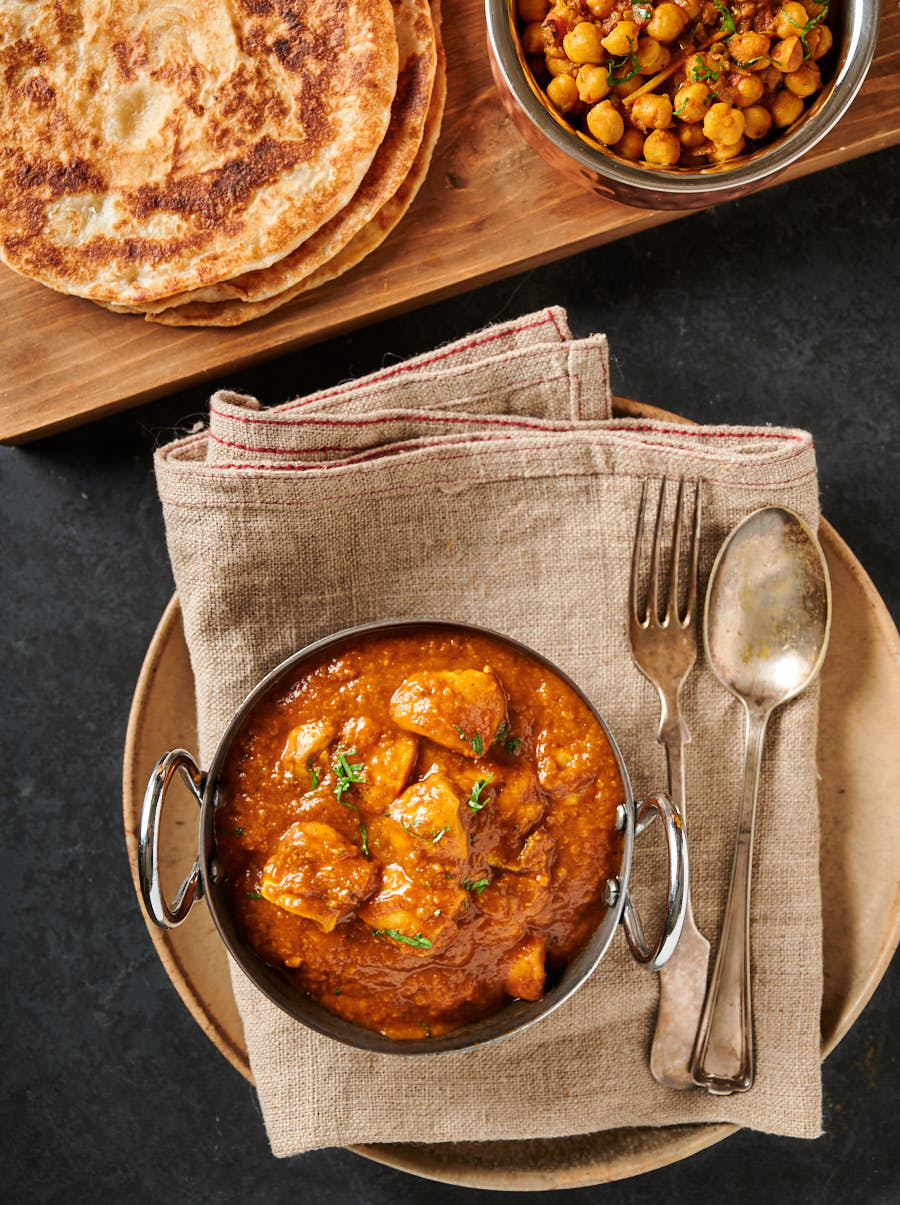
indian restaurant dhansak curry
Ingredients
The spice mix
- 2 tsp indian restaurant spice mix or curry powder – recipe link below
- 1 tsp kashmiri chili powder or 1/4 tsp cayenne mixed with 3/4 tsp paprika
- 1 tsp kasoor methi – dried fenugreek leaves
- 1/2 tsp kosher salt
The curry ingredients
- 3 Tbsp oil
- 1 Tbsp garlic/ginger paste – recipe link below
- 1 Tbsp tomato paste with enough water to dilute to the consistency of pasatta
- 15 oz curry base
- 1-2 Tbsp tamarind sauce (not the same as tamarind paste) – more will crank up the tart/sweet nature of this curry. If you want to substitute tamarind paste see the note below.
- 5-6 Tbsp cooked masoor dahl – make a tarka dahl and use a bit of the lentils in the dhansak
- 10-12 oz pre-cooked chicken or lamb
Instructions
- Make the spice mix.
- Dilute the tomato paste with enough water to get to the consistency of passata.
- Heat your frying pan (don’t use non-stick) briefly over medium heat. Add the oil. Use all the oil specified. It’s important.
- When the oil starts to shimmer add the garlic ginger paste. Add it into the pan and cook it, stirring constantly, until it stops sputtering.
- Turn down the heat and add the spice mix. This is the critical step. Stir it constantly for 30 seconds. If it starts to darken lift the pan off the heat. You want the spice mix to cook in the oil but not burn.
- Turn the heat up to medium high. Add the diluted tomato paste and stir until bubbles form (the oil will likely separate). This takes around 30 seconds to one minute depending on the heat.
- Add 3 oz of curry base. Stir until bubbles form (little craters really), around 30 seconds. Watch the edges of the pan. The curry can stick here.
- Now add 6 oz of curry base and stir briefly. Let it cook until the bubbles form again. This takes 1-2 minutes.
- Add the rest of the curry base and let cook until the bubbles form. Turn the heat down to low. Add the tamarind sauce to taste.
- Stir in the lentils.
- Now add the pre-cooked lamb, beef or chicken. For a vegetarian version add the paneer and/or pre-cooked vegetables.
- Let the curry simmer for about 5 minutes. If it gets too thick add a bit more curry base. Don’t add water.
- Garnish with a bit of chopped fresh cilantro and serve.
Notes
Nutrition