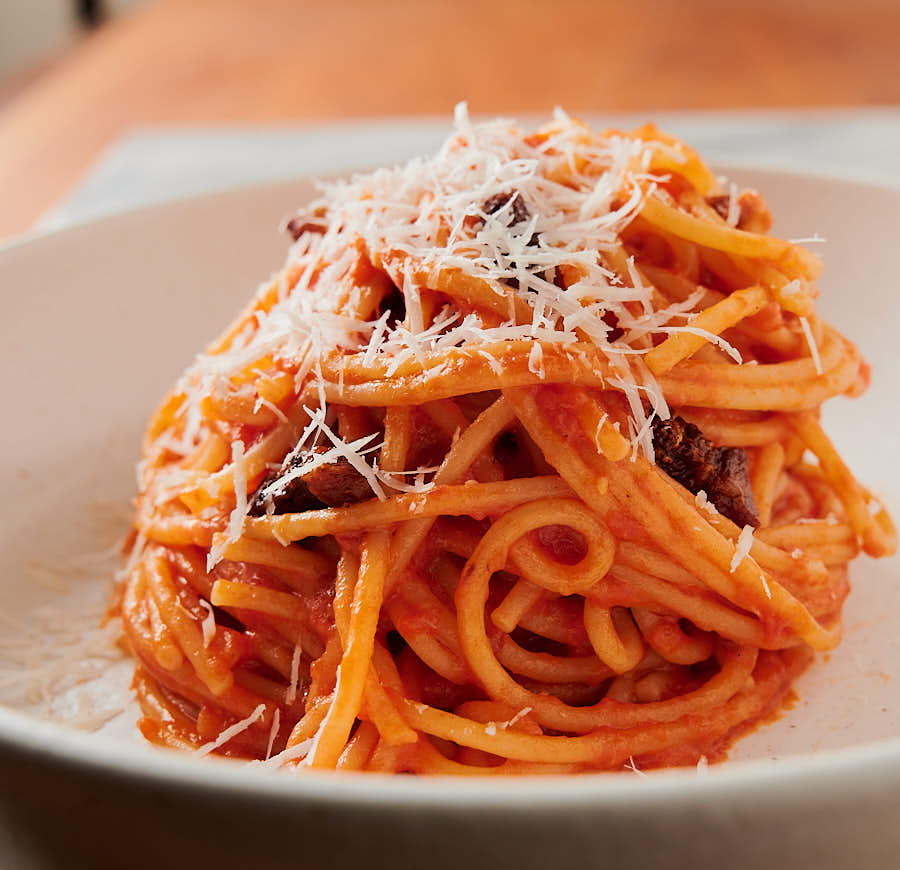
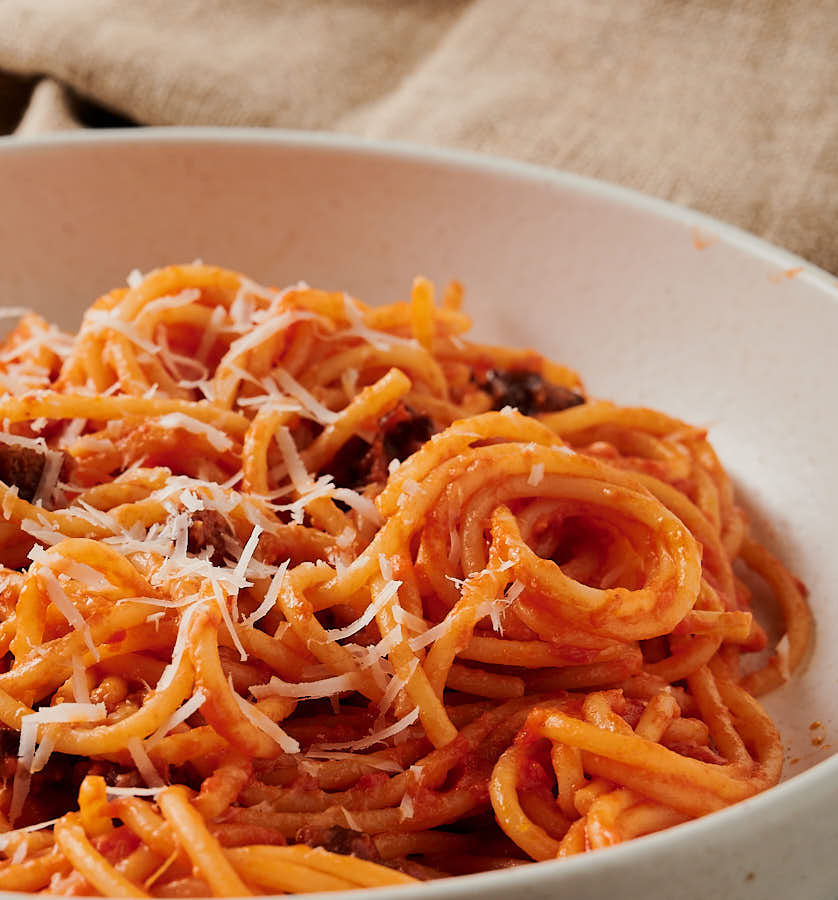
Spaghetti all’amatriciana. Five ingredients. Fifteen minutes from fridge to table. One magical plate of pasta.
Tangy cheese. Crispy cured pork bits. Spaghetti. Pork. Tomato. With a bit of crushed chili to liven things up.
Diabolically simple. Unbelievably delicious. This one is a bit of a weeknight dinner miracle.
The four pastas of Rome
Amatriciana is one of the four great Roman pasta dishes. A group of seriously delicious dishes.
You’ve probably heard of two of them. And probably never heard of the other two. Actually – if you’re here you’ve probably heard of three.
Carbonara is the most famous Roman pasta. Superstar status. Everybody loves carbonara. Including me.
Cacio e pepe is the other famous one. Literally means cheese and pepper. Three ingredients. And one of them is pepper. Minimalism at its finest.
Grigia is one that nobody has ever heard of. Think carbonara without the egg. Or cacio e pepe with porky goodness. Very tasty stuff.
And then there’s amatriciana. It stands alone. Tomato based. Tastes like a deconstructed Neapolitan lasagna.
This one surprised me. It’s becoming my favourite of the four.
Stop and think about that. I’m saying I think I like amatriciana. Over carbonara.
I did not see that one coming…
Five ingredients make one amazing dish
Spaghetti all’amatriciana has five ingredients. And one of them is spaghetti. So ingredients matter. A lot. There is nowhere to hide. Nowhere at all.
Pay attention to what you put into amatriciana. Because what you put in is what you’ll get out.
This is an easy recipe. Almost impossible to screw up. As long as you make the right the choices. Before you start cooking.
Canned tomatoes for the win
Sometimes fresh isn’t better. It’s pretty rare. I agree. But it does happen. This is one of those times.
Amatriciana screams for canned tomatoes. It’s just a thing. Accept it. I did. And I’m better off for it. You will be too.
This is a fast sauce. A quick dinner. No way you can make it in 15 minutes with fresh tomatoes.
Let’s be honest with ourselves. Off-season tomatoes suck. Food cooked using off-season tomatoes also sucks. Garbage in. Garbage out.
I like tomatoes from San Marzano here. If you can’t get those there are other great canned tomatoes out there.
Don’t skimp here. Pick a good quality brand. Did I mention there’s nowhere to hide?
The power of vitamin P
Want to really want to understand what this dish is about? Make it with guanciale. There’s a reason why the real deal recipes call for it.
Guanciale is cured pork jowl. It’s fatty. Really fatty. Which is part of the magic. Fry it up and it throws a bunch of rendered pork fat. Lush, delicious pork fat flavour.
And what’s left is wonderful little bits of crispy piggy candy. Crispy and meltingly tender at the same time.
Pancetta is a mediocre substitute for guanciale. It’s not the same. And it’s not as good in this recipe.
Fried guanciale chunks are porky flavour bombs. If you fry pancetta chunks they gets a little chewy. Just not that good.
I have to drive across town to get guanciale. I can walk to buy pancetta. So I drive. Every single time.
If you do need to use pancetta get your deli guy to cut it thin. And chop it up so the pieces disappear into the sauce. That way you get flavour without the chewy thing.
You’ll have to add some extra fat though. A little olive oil or better yet rendered pork lard should fix you up.
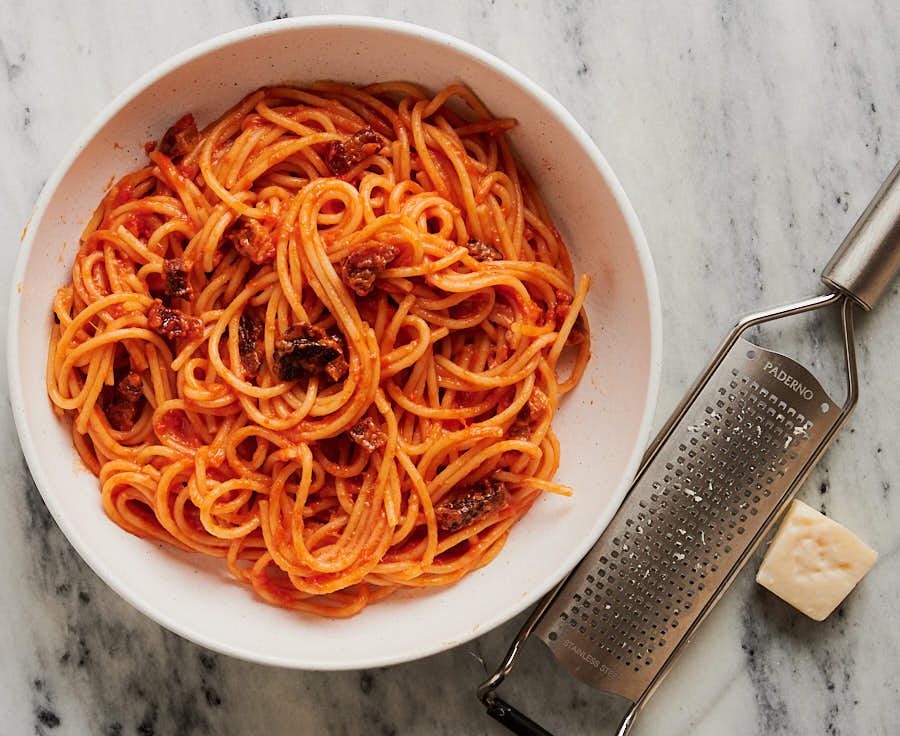
It’s time you got to know pecorino romano
Everybody knows parmigiano reggiano. You’d think they only made one cheese in Italy.
Don’t get me wrong. Parmigiano reggiano is a great cheese. I always have a piece in my fridge.
But variety is the spice of life. And pecorino romano is that spice. The rowdy cousin.
Parmigiano is a cow’s milk smooth. Creamy. Lush. Delicate. Balanced. The perfect complement to many Italian dishes.
Pecorino romano is none of those things. It’s brash. Salty. In your face assertive. And that makes it perfect for amatriciana.
Perfect for the other three Roman pastas as well. If you’re into carbonara you absolutely need pecorino romano in your fridge.
Pasta choices matter
All pastas are not created equal. It never ceases to amaze me. People will spend all day making the most beautiful ragu bolognese. And serve it up on crappy pasta.
A whole day in the kitchen to make a $100 pot of sauce. Thrown away because $5 is too much to spend on spaghetti. It hurts my brain.
FWIW not choosing tagliatelle for bolognese also hurts my brain. A lot.
Google is your friend here. Search “best pasta near me”. Or “best pasta brands”.
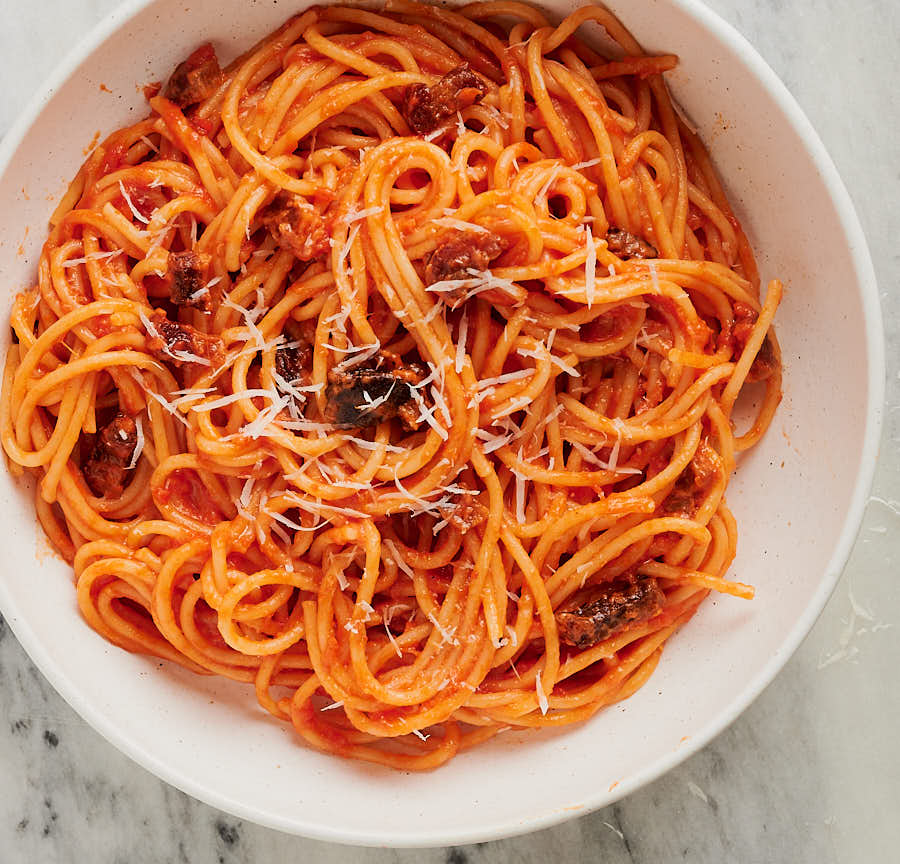
Look for something bronze cut. A little texture on the surface. Avoid the sauce-repelling super smooth teflon cut brands you see in grocery stores. Just because a pasta claims to be number one in Italy doesn’t mean it’s good…
Please just try good pasta once. Then decide whether the premium is worth the money. I’m guessing you will.
Spaghetti – not bucatini
Those that know will be saying bucatini is the right choice for amatriciana. That it’s bucatini all’amatriciana. And they would be right.
Technically bucatini is the right choice here. I am not suggesting otherwise. If you want the absolute real deal this is the way.
But bucatini is messy. Hard to eat. It has a super power. A single strand of bucatini all’amatriciana can ruin your shirt.
It is possibly the most difficult pasta to eat known to humankind. Trust me. I have the dry cleaning bills to prove it.
So I go with spaghetti. And I am unrepentant. I find the balance of pasta to sauce to be better. And I’m sick of paying my cleaner for my mistakes…
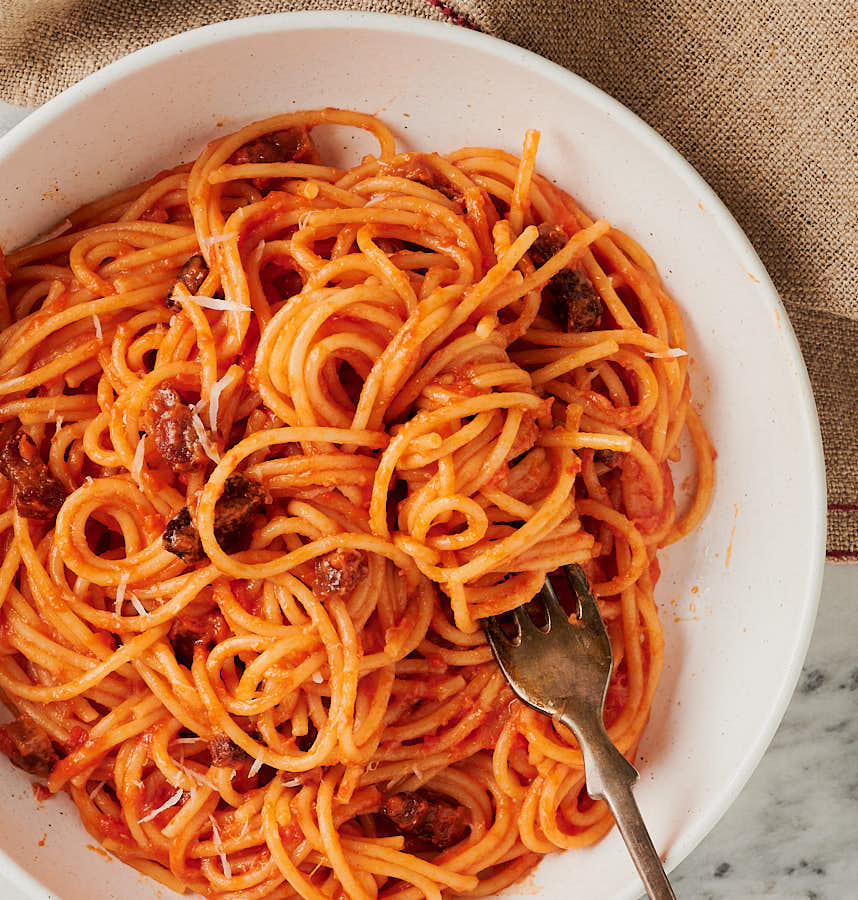
More can be less
Yes. You read that right. More is less. That’s actually the incredible thing about this recipe. Try to add something and it’s a safe bet you’ll take things backwards.
Onion. Garlic. Olive oil. White wine. Red wine. Parmigiano reggiano. They all sound good. And yet none of them are.
The magic that is Amatriciana comes from tomato, pork, the salty tang of pecorino romano with a little chili to wake things up. That’s it.
I tried to “improve” this dish. I failed. Miserably. Don’t do what I did. Keep the faith. You’ll get to the end game way faster than I did.
This could be your new favourite Tuesday night dinner
Amatriciana is a bit of a conundrum. Five ingredients. Fifteen minutes. That’s 11 minutes and 2 more ingredients than a peanut butter and jelly sandwich.
And yet the flavours are complex. Satisfying. The interplay of the rich pork fat, acidic tomatoes and salty cheese come together to make something far more than the sum of the parts.
This one crept up on me. Worked its way into my short list of favourite pasta dishes. Up there with a good lasagna. Carbonara. Neapolitan ragu.
For me that’s pretty lofty for a dish with five ingredients. One that you can bang together any night of the week.
Try spaghetti all’amatriciana. The same thing might just happen to you.
Spaghetti all’amatriciana
Equipment
- 1 large frying pan – you want something large enough to toss the pasta with the sauce
Ingredients
- 3 oz guanciale one 1/3 inch slice – don’t get too hung up on being precise with the weight
- 1/4 tsp chili flakes
- 14 oz canned tomatoes – go for quality here
- 2 oz pecorino romano – grated. It needs to melt into the sauce. A microplane works really well for this.
- 8 oz spaghetti – again, go for quality
- fresh ground pepper – if that’s your thing. I like it some days. Some days I go without.
Instructions
Get everything ready
- You’re making spaghetti so put a big pot of water on to boil. Add a bunch of salt. You want the water to taste like the sea. It takes more than you think.
- Cut up your guanciale into 1/4 inch by 1/2 inch pieces. You don’t need to be super precise here. This isn’t baking
- Pass your tomatoes through a food mill if you have one. Use your hands to smush them up if you don’t. It’s fun.
- Grate your pecorino.
Make amatriciana
- There are a lot of detailed steps. Don’t let that freak you out. This is basically frying up the guanciale, seasoning with a little crushed chili, simmering some tomatoes, tossing some pasta in the sauce and adding cheese. It really is that easy. Easy weeknight cooking once you get it down.
- Grab a big skillet. You will be tossing your pasta in the sauce so plan ahead.
- Preheat your chosen skillet over medium heat.
- Add the guanciale and cook, stirring frequently until you have beautiful little crispy pork bits. Remove the skillet from the heat.
- Remove the pork bits with a slotted spoon and look at how much fat has rendered. You want about two tablespoons or so in the pan. Depending on how fatty your guanciale is you may have a little more or a lot more. Remove all but two tablespoons. Use a spoon and be careful. You are playing with hot fat in a hot pan. That’s a pretty lethal combination.
- Make sure your pot of water is at a rolling boil. I mean cranked. Salt your water. Now salt it some more. You want your water to taste like the sea.
- Look at your spaghetti package. There will be a recommended cooking time on it. Set a timer for one minute less than the recommended cooking time and add your spaghetti to your pasta pot. As soon as you can get it all submerged start the timer.
- Add the chili flakes and return the pan to the heat. Give the chili flakes a stir and cook for about 20 seconds then add in the tomatoes.
- Scrape up any browned bits in the pan and simmer the sauce for 5 minutes or until your pasta timer goes off.
- Toss the reserved crispy guanciale pork bits into the sauce. You can hold a few bits back to sprinkle over the amatriciana after you plate. Up to you.
- Transfer the almost cooked pasta to the skillet along with about a 1/4 cup of the pasta cooking water. Toss to combine the pasta with the sauce and cook for about a minute.
- Don’t worry if it looks a little runny. The pecorino romano will fix that. Have faith.
- Set a bit of cheese aside to garnish. Off heat, add half the pecorino. Toss to combine. Add the other half and toss again.
- You don’t want to wait to serve. Spaghetti all’amatriciana doesn’t get better with age. Get it on the table!
- Serve topped with a bit of pecorino romano and the reserved guanciale bits if you kept them. A little grind of black pepper is a nice touch.
Nutrition
Spaghetti all’amatriciana
Equipment
- 1 large frying pan - you want something large enough to toss the pasta with the sauce
Ingredients
- 3 oz guanciale one 1/3 inch slice - don’t get too hung up on being precise with the weight
- 1/4 tsp chili flakes
- 14 oz canned tomatoes - go for quality here
- 2 oz pecorino romano - grated. It needs to melt into the sauce. A microplane works really well for this.
- 8 oz spaghetti - again, go for quality
- fresh ground pepper - if that’s your thing. I like it some days. Some days I go without.
Instructions
Get everything ready
- You’re making spaghetti so put a big pot of water on to boil. Add a bunch of salt. You want the water to taste like the sea. It takes more than you think.
- Cut up your guanciale into 1/4 inch by 1/2 inch pieces. You don’t need to be super precise here. This isn’t baking
- Pass your tomatoes through a food mill if you have one. Use your hands to smush them up if you don’t. It’s fun.
- Grate your pecorino.
Make amatriciana
- There are a lot of detailed steps. Don’t let that freak you out. This is basically frying up the guanciale, seasoning with a little crushed chili, simmering some tomatoes, tossing some pasta in the sauce and adding cheese. It really is that easy. Easy weeknight cooking once you get it down.
- Grab a big skillet. You will be tossing your pasta in the sauce so plan ahead.
- Preheat your chosen skillet over medium heat.
- Add the guanciale and cook, stirring frequently until you have beautiful little crispy pork bits. Remove the skillet from the heat.
- Remove the pork bits with a slotted spoon and look at how much fat has rendered. You want about two tablespoons or so in the pan. Depending on how fatty your guanciale is you may have a little more or a lot more. Remove all but two tablespoons. Use a spoon and be careful. You are playing with hot fat in a hot pan. That’s a pretty lethal combination.
- Make sure your pot of water is at a rolling boil. I mean cranked. Salt your water. Now salt it some more. You want your water to taste like the sea.
- Look at your spaghetti package. There will be a recommended cooking time on it. Set a timer for one minute less than the recommended cooking time and add your spaghetti to your pasta pot. As soon as you can get it all submerged start the timer.
- Add the chili flakes and return the pan to the heat. Give the chili flakes a stir and cook for about 20 seconds then add in the tomatoes.
- Scrape up any browned bits in the pan and simmer the sauce for 5 minutes or until your pasta timer goes off.
- Toss the reserved crispy guanciale pork bits into the sauce. You can hold a few bits back to sprinkle over the amatriciana after you plate. Up to you.
- Transfer the almost cooked pasta to the skillet along with about a 1/4 cup of the pasta cooking water. Toss to combine the pasta with the sauce and cook for about a minute.
- Don’t worry if it looks a little runny. The pecorino romano will fix that. Have faith.
- Set a bit of cheese aside to garnish. Off heat, add half the pecorino. Toss to combine. Add the other half and toss again.
- You don’t want to wait to serve. Spaghetti all’amatriciana doesn’t get better with age. Get it on the table!
- Serve topped with a bit of pecorino romano and the reserved guanciale bits if you kept them. A little grind of black pepper is a nice touch.
Nutrition
Tom kha gai is one crazy tasty bowl of creamy delicious Thai chicken soup. This is sort of that recipe. But not quite.
Confused? Understandable. Think tom kha gai. Add the satisfying slurp of noodles. That’s everything good. In one big bowl of delicious noodle soup. That’s what this is.
The gentle heat of Thai red curry. The sour tang of lime leaf. Tender bits of chicken. And rice noodles. All wrapped up in creamy coconut milk. Irresistible.
This is a story about the noodle dish that wasn’t. But should have been. I really don’t get why this one isn’t huge.
Some day I’ll serve this at my imaginary food truck. And my imaginary customers will line up as far as the eye can see.
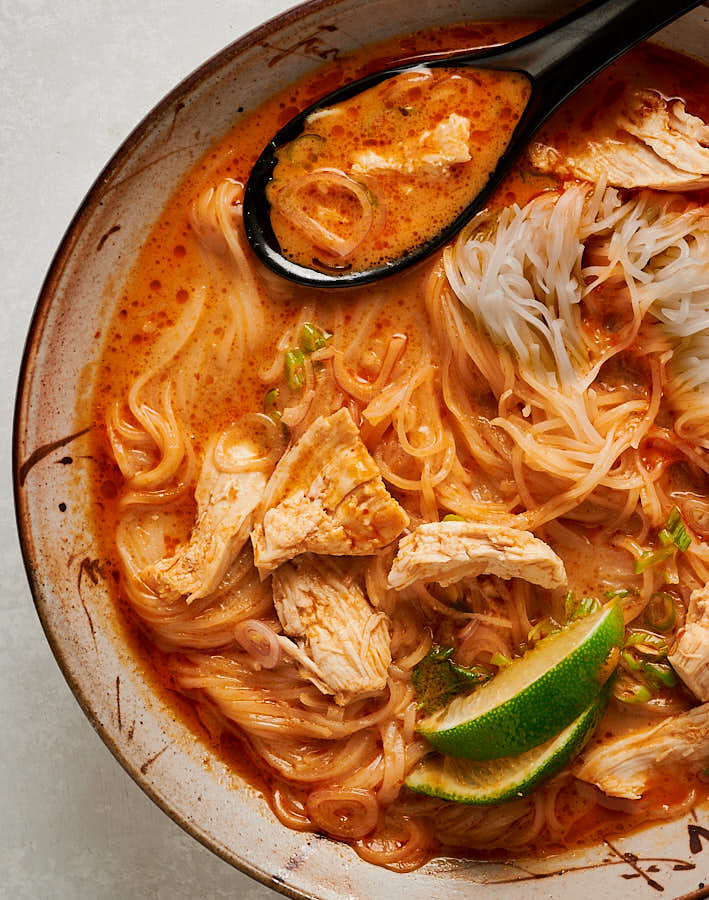
Balanced – in that magical south East Asian way
Tom kha gai noodle soup hits you from all directions. Bit of a flavour bomb. A lot of things going on.
Hot. Sour. Salty. Sweet. In balance. Those four flavours shape south east Asian cuisine. At least that’s what I think of when I cook food from this part of the world.
It’s not the whole story. But it is a big part. Often helps me find my way. Culinary guard rails really.
Goes like this. Hmmm… Something’s not quite right. Stop. Taste. One of the four need tweaking? Adjust. Taste again. That thinking has saved me more than once.
This one is a perfect example. It’s hot. Sour. Salty. And a little bit sweet.
Noodling on tom kha gai
This is where I’d normally tell you a story about the history of tom kha gai noodle soup.
How it dates back to the 13th century. Invented for a banquet at the court of King Ramkhamhaeng.
I’d say this is a recipe handed down generation to generation by the chosen ones. The tom kha gai noodle soup secret society. An organization that has kept the faith for a thousand years.
Except that tom kha gai noodle soup doesn’t exist. It’s not a thing. Not yet anyway. But I think it will. Someday. Somehow. This one is too good to contain.
To be fair – the only reason I know is because I went to lunch with a couple of buddies. They both ordered tom kha gai noodle soup.
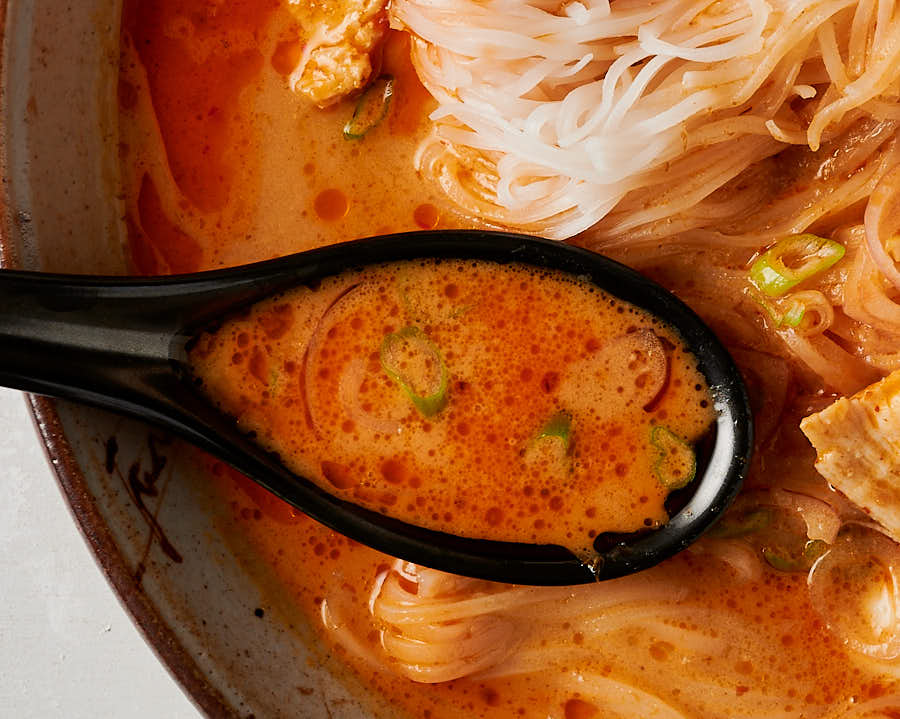
I asked for a spoonful. Just a little taste of broth. Put it into my mouth. And my world exploded…
Authenticity score 2. Deliciousness score 9. That’s OK with me. Delicious trumps authentic. Every. Single. Time.
So I don’t care. And I’m guessing you won’t either. One spoonful of this broth. And you will know.
Restaurant hacks for the win
Truly great Thai restaurants make their own pastes from scratch. The rest of them use stuff they can buy. Turns out you can buy the same stuff.
Weeknight dinner meets restaurant hack. Easy. Seriously tasty. The ideal formula for weeknights. Fast in a restaurant. And fast in your kitchen.
Thai red curry paste. That’s the first piece of the puzzle. You can get it just about anywhere. And you can use it all over the place.
Thai red chicken curry. Obviously. Seriously amazing pork burgers. Slide a bit into a stir fry. Toss it with green beans for a spicy side. It’s handy stuff to have around.
Tom yum paste for the win
Traditional tom kha gai calls for galangal, lemongrass, chilies and kaffir lime leaves. That’s a trip to an Asian grocer. And a lot of work. Every time you want this soup.
Or you can go to the Asian grocer once. Buy a jar of tom yum paste. Hot and sour soup paste. Has all the ingredients built in.
No shopping. No chopping. And no grinding. Just open up a jar and go. Easy. And I genuinely like it. Even though it’s from a jar.
Purists will stop reading now. I respect that. But that makes me a bit sad. Because they will miss out. Or make it on a weekend I guess. Without the noodles I bet.
But I’ll eat mine on a Tuesday. With noodles. I’ll serve it to friends on Saturday. And I’ll sleep well. With a full belly. And a smile on my face.
Use tom yum paste here. Make tom yum soup . Or just mix it with some boiling water in a mug for a salty sour treat. It’s tasty stuff. And it keeps forever.
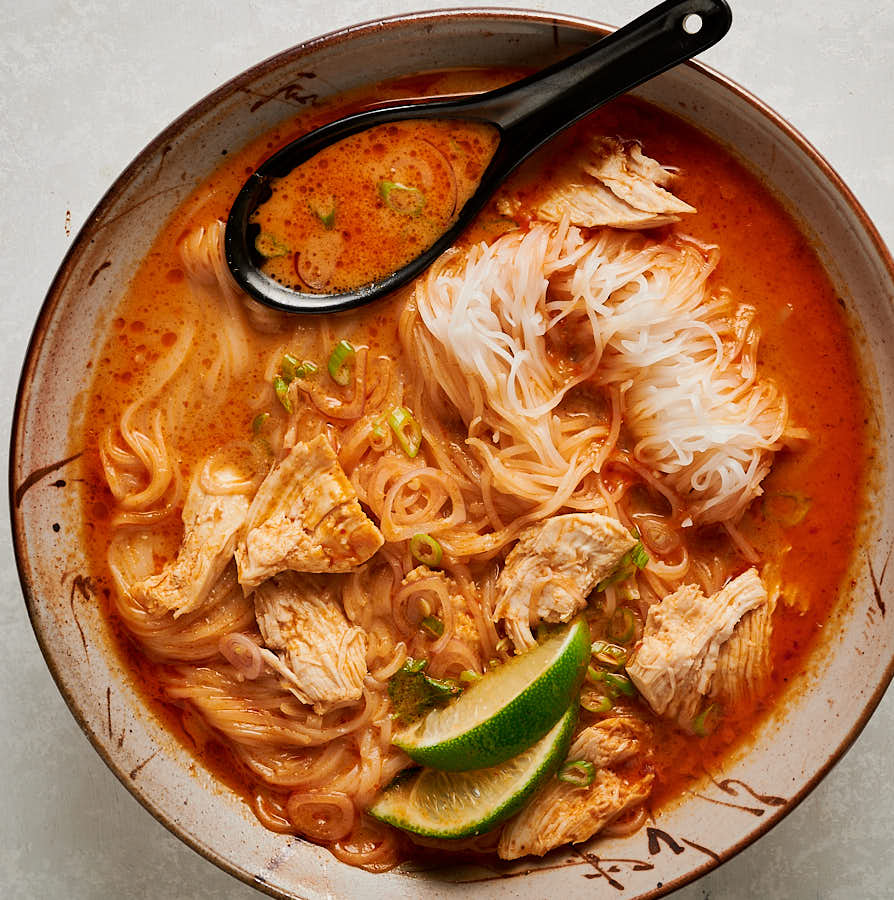
A hint of sweet
I don’t have a sweet tooth. My dentist checked. So it took me a long time to learn a very important lesson.
A bit of sugar in a savoury dish can be amazing. Transformative. As little as a teaspoon can completely change a dish.
I can’t describe it. You have to taste it to understand. Sugar has a super power. It can take a savoury dish from really good to incredible. Culinary alchemy.
This is one of those times. Without sugar this dish has a great balance of savoury, spicy and sour. You would think that would be enough.
Turns out it’s not. It’s tasty. But it doesn’t quite hang together. It’s just a bit too jangly.
Add a little sugar and everything changes. The flavours come together. Complex. And harmonious.
Try one teaspoon to start. That keeps things subtle. Does the trick without anyone realizing.
Two teaspoons is right for me. Not sweet. But noticeable. If you know what to taste for.
The restaurant I stole this recipe from uses more. A lot more. It starts to get noticeably sweet at around a tablespoon.
I can’t tell you what’s right for you. You’ll need to creep up on it and decide for yourself.
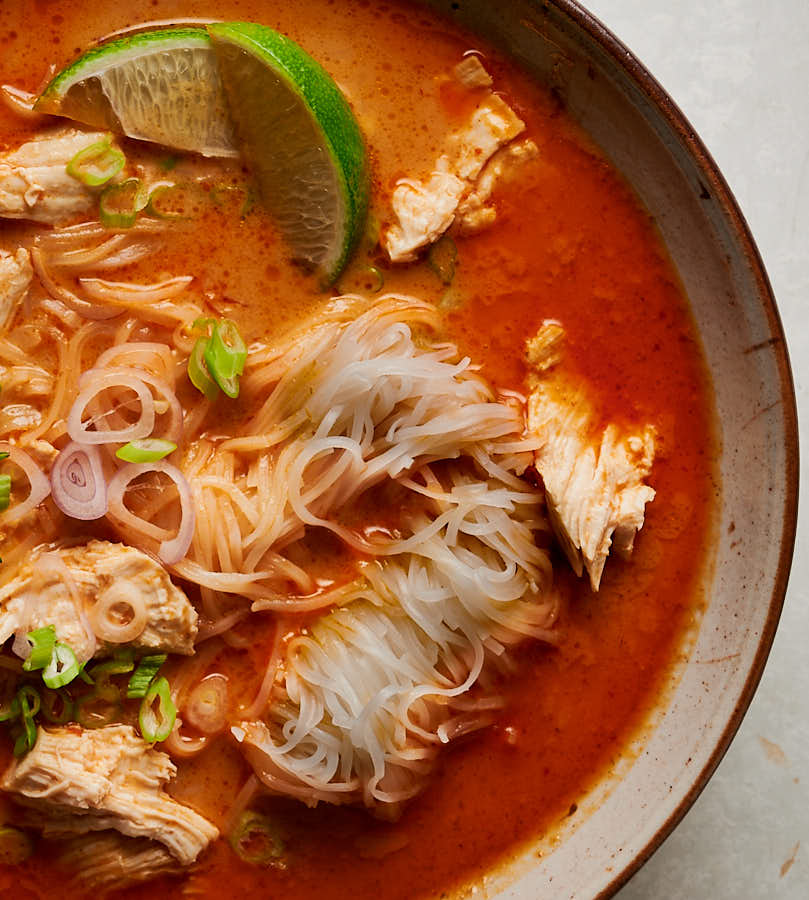
Great noodles for great noodle soup
This is a noodle soup. So the noodles are important. Really important. Which means you need to nail them.
Rice noodles can be tricky. Underdone rice noodles are hard. Just terrible. Overdone rice noodles are mushy. Slightly less terrible.
When you nail them they are great. It’s not hard. You just need to pay attention.
Ignore the package
Step one. Don’t read the instruction on the package. Seriously. I think water must boil at a different temperature in Thailand. All I ever get is pure mush.
Step two. Make everything else first. Chicken poached and sliced or shredded. Broth simmering on the stove. Garnishes at the ready. Serving bowls at hand.
Step three. Understand every brand is different. That’s important. You will need to learn your brand. It’s super annoying. But it’s a fact. At least now you know.
Bring a big pot of water with a strainer to a roiling boil. Or have your oven mitts handy. You are setting up for how you normally cook pasta.
Add the noodles. Cook for 30 seconds. If they are still hard cook them another 30 seconds. You are going for toothy. A little bite. A bit of chew. That’s perfect.
Noodles straight into a bowl. Hot broth ladled overtop. Chicken and garnish next. Hustle. Shouldn’t take more than 30 seconds total for two servings. A minute max.
Eat. Smile. Repeat once a week or as needed to keep smiling.
I’ve written this pretty much how they serve it at the restaurant I’m ripping off. Chicken. Broth. Noodles. Simple garnishes.
But there’s no reason not to play with this one. If you like it hot add a bit of fresh sliced red chili. The flavour profile will fit right in.
Shiitake mushrooms work great. Just make sure they’re cooked before they go in. Enoki mushrooms work too. Those can go in raw.
Anything that works with tom yum works. Anything that works with red Thai curry works. This one is a canvas awaiting your inspiration.
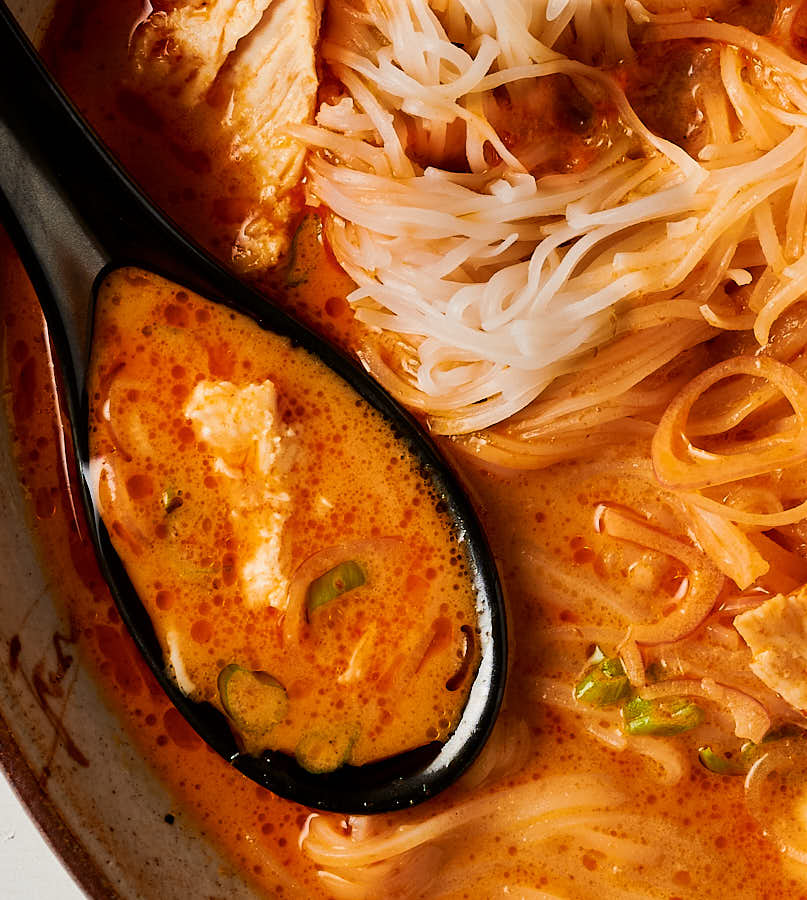
Shop once – make tom kha gai noodle soup often
I like complicated recipes. I go the distance every chance I get. But I live in the same inconvenient world you do.
The world with Tuesday nights. With busy schedules. Nights I stop to consider ordering highly overpriced takeout that never fails to disappoint.
Which is why I love this recipe. My kind of busy weeknight dinner.
Tom kha gai noodle soup is fast. And easy. Really tasty stuff. And almost no work at all. Especially if you poach your chicken ahead of time.
It’s tasty. It’s dead easy. Takes a couple slightly oddball ingredients. I get that. But those ingredients are versatile. And they keep forever.
Try tom kha gai noodle soup
This one is a little out there in left field. A dish that doesn’t exist. Not yet anyway.
But if enough of us start making it. And we tell our friends. And they make it. Then tell their friends. Then maybe the world will listen.
And then we can order it when we go out for lunch. Or maybe even get it for weeknight takeout. Takeout that doesn’t suck. That would be something.
If you like Asian noodle soups. And if you like Thai flavours. Then I’m guessing you will surprise yourself with tom kha gai noodle soup. Weeknight dinners don’t have to suck.
Tom kha gai
Ingredients
- 12 oz boneless, skinless chicken breast – or thighs
- 19 oz coconut milk – that’s not the secret amount that leads to success. That’s the size of a can where I live. 20 oz is fine 17.3 ounces is also fine.
- 19 oz chicken stock – low or no sodium added. Just pour it into the coconut milk can to measure it out.
- 1 tbsp thai red curry paste – store bought is fine
- 1 tsp tom yum paste – available at Asian grocers
- 2 tsp palm sugar – brown sugar works too. Note that you can add more sugar. I just like it less sweet. A tablespoon is noticeable though so don’t go crazy
- 8 oz rice noodles – banh pho
- sliced shallots, sliced green onions, lime wedges – to garnish
Instructions
- Bring a pot of water large enough to cook the rice noodles to a boil
- Wisk the stock and coconut milk together and bring to a simmer. Add the chicken breasts (or thighs) to the liquid and simmer gently until they reach 160F for white (breast) or 170F for dark (thigh). Set aside to rest.
- Strain the liquid if desired and return to the pot. Your call. The broth will have little bits in it. If that bothers you then strain. If you don’t care then don’t.
- Return the broth to a simmer. Add the red Thai curry and tom yum pastes into a bowl. Ladle in a little of the coconut milk broth and mix to combine. Trust me – it’s worth the extra dishes so you don’t have to chase bits of curry paste around in the pot.
- Add the red curry/tom yum mixture back into the coconut milk broth along with 2 tsp of brown or palm sugar. Taste. If you like things a little sweeter add another tsp of sugar. If you want things saltier add a bit of fish sauce. You probably won’t need it.
- Creep up on both the salt and sugar. Adding more is easy. Taking it away is impossible.
- Slice or shred your chicken. Sliced if you want things pretty. Shredded if you like bigger bites. Sliced makes for nicer pictures but I like shredded better.
- Add the rice noodles to the boiling water. Check after 30 seconds. If they are still toothy let them go another 30 seconds and check again. You want a bit of chew to the noodles.
- When you are happy with your noodles, drain and divide into two large bowls.
- If you sliced and are going for pretty then fan the chicken over the noodles and pour the broth overtop. If you shredded then the chicken can go in when you like.
- Garnish with your choice of sliced shallots, sliced green onion and lime. Enjoy!
